
$L$-isomer of a compound $A$ $(C_{4}H_{8}O_{4})$ gives a positive test with $[Ag(NH_{3})_{2}]^{+}$. Treatment of $A$ with acetic anhydride yields a triacetate derivative. Compound $A$ produces an optically active compound $B$ and an optically inactive compound $C$ on treatment with bromine water and $HNO_{3}$ respectively. Compound $A$ is ....
- A
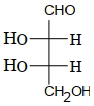
- B
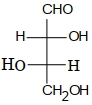
- C
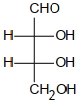
- D
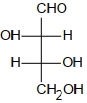
Explore More
Similar Questions
$\alpha-D(+)$ glucose and $\beta-D(+)$ glucose are
$(i)$ Diastereomers
$(ii)$ Geometrical isomers
$(iii)$ Epimers
$(iv)$ Anomers
$(v)$ Enantiomers
$(i)$ Diastereomers
$(ii)$ Geometrical isomers
$(iii)$ Epimers
$(iv)$ Anomers
$(v)$ Enantiomers
Easy
View SolutionSucrose is dextrorotatory,but the mixture obtained after hydrolysis is laevorotatory. Explain.
Medium
View Solution$Starch$ consists of two fractions; one is $\alpha-amylose$ and the other is
Easy
View SolutionWhich of the following derivatives is useful for the identification of reducing sugars?
Easy
View SolutionThe structure of $D-(+)$-glucose is given. What is the structure of $L-(-)$-glucose?
MediumIIT 2015
View SolutionVedclass Products
For Students
Vedclass Test Series
Mock tests in real JEE/NEET style with performance analysis. 5-day free trial.
Start Free TrialFor Teachers
Exam Paper Generator
Generate Set A/B/C/D exam papers from 7.5L+ questions in 2 minutes. 3 chapters free.
Try FreeFor Institutes
Online Exam Module
Live online exams with unlimited students, 360° analytics & white-label branding.
See Demo