
$A$ frictionless circular wire of unit radius is fixed on the horizontal plane. Two point particles of unit mass start moving simultaneously from point $A(\theta = \pi/2)$ with identical uniform angular speeds in opposite directions, and meet again at point $B(\theta = -\pi/2)$. During this time, which of the following figures schematically represent the magnitude of the total linear momentum $P$ of the system, as a function of $\theta$?
- A
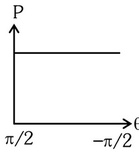
- B
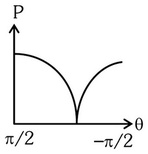
- C
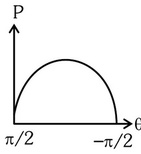
- D
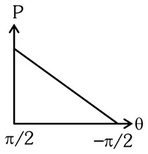
Explore More
Similar Questions
$A$ body of mass $1\, kg$ tied to one end of a string is revolved in a horizontal circle of radius $0.1\, m$ with a speed of $3$ revolutions per second. Assuming the effect of gravity is negligible,the linear velocity,acceleration,and tension in the string will be:
Medium
View Solution$A$ bomb is dropped from an aeroplane moving horizontally at a constant speed. When air resistance is taken into consideration,the bomb
Easy
View Solution$A$ particle of mass $m$ moves with constant speed $v$ on a circular path of radius $r$ as shown in the figure. The average force on it during its motion from $A$ to $B$ is
Medium
View SolutionAt any time $t$,the coordinates of a moving particle are $x = at^2$ and $y = bt^2$. The speed of the particle is
Range of a bullet fired at $45^o$ to the horizontal is $980 \, m$. If the bullet is fired at the same angle from a car travelling horizontally at $18 \, km/h$ towards the target,then the range will be increased by:
Difficult
View SolutionVedclass Products
For Students
Vedclass Test Series
Mock tests in real JEE/NEET style with performance analysis. 5-day free trial.
Start Free TrialFor Teachers
Exam Paper Generator
Generate Set A/B/C/D exam papers from 7.5L+ questions in 2 minutes. 3 chapters free.
Try FreeFor Institutes
Online Exam Module
Live online exams with unlimited students, 360° analytics & white-label branding.
See Demo