
$A$ particle is constrained to move along the $x$-axis. $A$ force is applied to it in the same direction,which varies with the distance $x$ from the origin as $F(x) = -kx + ax^3$,where $k$ and $a$ are positive constants. What will be the graph of the potential energy $U(x)$ of the particle for $x \ge 0$?
- A
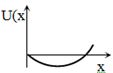
- B
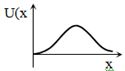
- C
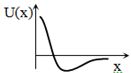
- D
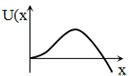
Explore More
Similar Questions
For the stability of a physical system,what should be its potential energy? Should it be more or less?
Easy
View Solution$A$ particle with constant total energy $E$ moves in one dimension in a region where the potential energy is $U(x)$. The speed of the particle is zero where
Medium
View Solution$A$ uniform chain of length $L$ and mass $M$ is lying on a smooth table and one-third of its length is hanging vertically down over the edge of the table. If $g$ is the acceleration due to gravity, the work required to pull the hanging part onto the table is
DifficultIIT 1985
View Solution$A$ particle is placed at the origin and a force $F = kx$ is acting on it (where $k$ is a positive constant). If $U(0) = 0$,the graph of $U(x)$ versus $x$ will be (where $U$ is the potential energy function):
$A$ particle moving along the $X$-axis has potential energy $U = 2 - 20x + 5x^2 \text{ J}$. The particle is released at $x = -3 \text{ m}$. What is the maximum value of $x$ reached by the particle (in $\text{ m}$)? ($x$ is in meters and $U$ is in joules)
Vedclass Products
For Students
Vedclass Test Series
Mock tests in real JEE/NEET style with performance analysis. 5-day free trial.
Start Free TrialFor Teachers
Exam Paper Generator
Generate Set A/B/C/D exam papers from 7.5L+ questions in 2 minutes. 3 chapters free.
Try FreeFor Institutes
Online Exam Module
Live online exams with unlimited students, 360° analytics & white-label branding.
See Demo