
Class 11PhysicsSystem of Particles and Rotational MotionMix Example - System of Particles and Rotational Motion
EasyThe moment of inertia of a sphere of mass $M$ and radius $R$ is $I$. Which graph represents the variation of $I$ with respect to $R$,keeping $M$ constant?
- A
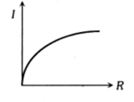
- B
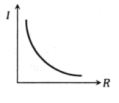
- C
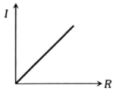
- D
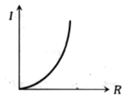
Explore More
Similar Questions
$A$ solid sphere is in purely rotational motion about its diameter. The ratio of its angular momentum $(L)$ and kinetic energy $(K)$ is $\frac{\pi}{22}$. Find the angular velocity $(\omega)$ of the sphere. (Take $\pi = \frac{22}{7}$) (in $rad/s$)
$A$ thin and uniform rod of mass $M$ and length $L$ is held vertical on a floor with large friction. The rod is released from rest so that it falls by rotating about its contact-point with the floor without slipping. Which of the following statement$(s)$ is/are correct,when the rod makes an angle $60^{\circ}$ with vertical? [$g$ is the acceleration due to gravity]
$(1)$ The radial acceleration of the rod's center of mass will be $\frac{3g}{4}$
$(2)$ The angular acceleration of the rod will be $\frac{3\sqrt{3}g}{4L}$
$(3)$ The angular speed of the rod will be $\sqrt{\frac{3g}{2L}}$
$(4)$ The normal reaction force from the floor on the rod will be $\frac{Mg}{16}$
$(1)$ The radial acceleration of the rod's center of mass will be $\frac{3g}{4}$
$(2)$ The angular acceleration of the rod will be $\frac{3\sqrt{3}g}{4L}$
$(3)$ The angular speed of the rod will be $\sqrt{\frac{3g}{2L}}$
$(4)$ The normal reaction force from the floor on the rod will be $\frac{Mg}{16}$
$A$ rotating body has angular momentum $L$. If its frequency is doubled and its kinetic energy is halved,what will be its new angular momentum?
$A$ flywheel rotates about an axis. Due to friction at the axis,it experiences an angular retardation proportional to its angular velocity. If its angular velocity falls to half while it makes $n$ rotations,how many more rotations will it make before coming to rest?
DifficultAIIMS 2013
View SolutionThe figure shows a system consisting of $(i)$ a ring of outer radius $3R$ rolling clockwise without slipping on a horizontal surface with angular speed $\omega$ and $(ii)$ an inner disc of radius $2R$ rotating anti-clockwise with angular speed $\omega/2$. The ring and disc are separated by frictionless ball bearings. The system is in the $x-z$ plane. The point $P$ on the inner disc is at distance $R$ from the origin,where $OP$ makes an angle of $30^{\circ}$ with the horizontal. Then with respect to the horizontal surface,
$(A)$ the point $O$ has linear velocity $3R\omega\hat{i}$.
$(B)$ the point $P$ has a linear velocity $\frac{11}{4}R\omega\hat{i} + \frac{\sqrt{3}}{4}R\omega\hat{k}$.
$(C)$ the point $P$ has linear velocity $\frac{13}{4}R\omega\hat{i} - \frac{\sqrt{3}}{4}R\omega\hat{k}$.
$(D)$ The point $P$ has a linear velocity $(3 - \frac{\sqrt{3}}{4})R\omega\hat{i} + \frac{1}{4}R\omega\hat{k}$.
$(A)$ the point $O$ has linear velocity $3R\omega\hat{i}$.
$(B)$ the point $P$ has a linear velocity $\frac{11}{4}R\omega\hat{i} + \frac{\sqrt{3}}{4}R\omega\hat{k}$.
$(C)$ the point $P$ has linear velocity $\frac{13}{4}R\omega\hat{i} - \frac{\sqrt{3}}{4}R\omega\hat{k}$.
$(D)$ The point $P$ has a linear velocity $(3 - \frac{\sqrt{3}}{4})R\omega\hat{i} + \frac{1}{4}R\omega\hat{k}$.
Vedclass Products
For Students
Vedclass Test Series
Mock tests in real JEE/NEET style with performance analysis. 5-day free trial.
Start Free TrialFor Teachers
Exam Paper Generator
Generate Set A/B/C/D exam papers from 7.5L+ questions in 2 minutes. 3 chapters free.
Try FreeFor Institutes
Online Exam Module
Live online exams with unlimited students, 360° analytics & white-label branding.
See Demo