
$A$ thin rod of length $L$ is placed along the $X$-axis such that one of its ends is at $x = 0$ and the other is at $x = L$. Its linear mass density (mass/length) varies with $x$ as $k(x/L)^n$,where $n$ is any positive number or zero. If the graph of the center of mass $x_{cm}$ versus $n$ is plotted for the rod,which of the following graphs is correct?
- A
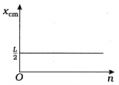
- B
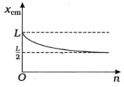
- C
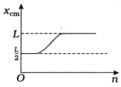
- D
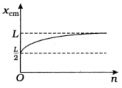
Explore More
Similar Questions
Consider a two-particle system with particles having masses $m_1$ and $m_2$. If the first particle is pushed towards the center of mass through a distance $d$,by what distance should the second particle be moved so as to keep the center of mass at the same position?
MediumAIPMT 2004
View SolutionTwo objects of mass $10\,kg$ and $20\,kg$ respectively are connected to the two ends of a rigid rod of length $10\,m$ with negligible mass. The distance of the center of mass of the system from the $10\,kg$ mass is:
MediumNEET 2022
View SolutionFour particles of masses $m_1 = 2m$,$m_2 = 4m$,$m_3 = m$,and $m_4$ are placed at the four corners of a square. What should be the value of $m_4$ so that the centre of mass of all the four particles is exactly at the centre of the square?
$A$ slender uniform rod of length $L$ is balanced vertically at a point $P$ on a horizontal surface having some friction. If the top of the rod is displaced slightly to the right,the position of its centre of mass at the time when the rod becomes horizontal is:
Medium
View SolutionIs the statement "$A$ particle has point volume" true or false?
Easy
View SolutionVedclass Products
For Students
Vedclass Test Series
Mock tests in real JEE/NEET style with performance analysis. 5-day free trial.
Start Free TrialFor Teachers
Exam Paper Generator
Generate Set A/B/C/D exam papers from 7.5L+ questions in 2 minutes. 3 chapters free.
Try FreeFor Institutes
Online Exam Module
Live online exams with unlimited students, 360° analytics & white-label branding.
See Demo