
The energy spectrum of $\beta$-particles [number $N(E)$ as a function of $\beta$-energy $E$] emitted from a radioactive source is:
- A
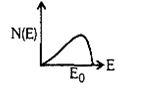
- B
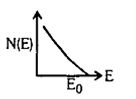
- C
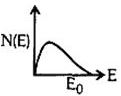
- D
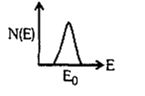
Explore More
Similar Questions
$A$ $2\,\mu F$ capacitor is charged as shown in the figure. The percentage of its stored energy dissipated after the switch $S$ is turned to position $2$ is.....$\%$
Two cylinders $A$ and $B$ fitted with pistons,contain equal number of moles of an ideal monoatomic gas at $400 ~K$. The piston of $A$ is free to move while that of $B$ is held fixed. Same amount of heat energy is given to the gas in each cylinder. If the rise in temperature of the gas in $A$ is $42 ~K$,the rise in temperature of the gas in $B$ is $(\gamma = 5/3)$. (in $~K$)
$A$ plane passes through $(2,3,-1)$ and is perpendicular to the line having direction ratios $3,-4,7$. The perpendicular distance from the origin to this plane is
$A$ particle is released from height $S$ from the surface of the Earth. At a certain height its kinetic energy is three times its potential energy. The height from the surface of the Earth and the speed of the particle at that instant are respectively:
If $g$ is the acceleration due to gravity on the earth's surface,the gain in the potential energy of an object of mass $m$ raised from the surface of the earth to a height equal to the radius $R$ of the earth is
Vedclass Products
For Students
Vedclass Test Series
Mock tests in real JEE/NEET style with performance analysis. 5-day free trial.
Start Free TrialFor Teachers
Exam Paper Generator
Generate Set A/B/C/D exam papers from 7.5L+ questions in 2 minutes. 3 chapters free.
Try FreeFor Institutes
Online Exam Module
Live online exams with unlimited students, 360° analytics & white-label branding.
See Demo