
$A$ charge $Q$ is uniformly distributed over the volume of an insulating sphere of radius $R$. $A$ thin metal shell of radius $b$ $(b > R)$ with a charge $-Q$ is placed around the sphere. The space between the sphere and the shell is filled with air. Which of the following graphs correctly represents the electric field $E$ as a function of distance $r$ from the center?
- A
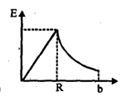
- B
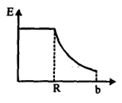
- C
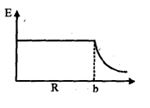
- D
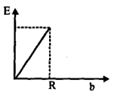
Explore More
Similar Questions
Which of the following statement$(s)$ is/are correct?
$(A)$ If the electric field due to a point charge varies as $r^{-2.5}$ instead of $r^{-2}$,then the Gauss law will still be valid.
$(B)$ The Gauss law can be used to calculate the field distribution around an electric dipole.
$(C)$ If the electric field between two point charges is zero somewhere,then the sign of the two charges is the same.
$(D)$ The work done by the external force in moving a unit positive charge from point $A$ at potential $V_A$ to point $B$ at potential $V_B$ is $(V_B - V_A)$.
$(A)$ If the electric field due to a point charge varies as $r^{-2.5}$ instead of $r^{-2}$,then the Gauss law will still be valid.
$(B)$ The Gauss law can be used to calculate the field distribution around an electric dipole.
$(C)$ If the electric field between two point charges is zero somewhere,then the sign of the two charges is the same.
$(D)$ The work done by the external force in moving a unit positive charge from point $A$ at potential $V_A$ to point $B$ at potential $V_B$ is $(V_B - V_A)$.
DifficultIIT 2011
View Solution$A$ point charge '$Q$' is placed at the centre of the line joining two equal charges '$+q$' and '$+q$'. The value of '$Q$' when the system is in equilibrium is
DifficultMHT CET 2026
View SolutionAssertion: Consider two identical charges placed at a distance $2d$ apart along the $x-$axis. The equilibrium of a positive test charge placed at the point $O$ midway between them is stable for displacements along the $x-$axis.
Reason: The net force on the test charge at point $O$ is zero.
Reason: The net force on the test charge at point $O$ is zero.
An infinite plane sheet of charge having uniform surface charge density $+\sigma_s \text{ C/m}^2$ is placed on the $x-y$ plane. Another infinitely long line charge having uniform linear charge density $+\lambda_e \text{ C/m}$ is placed at the $z=4 \text{ m}$ plane and is parallel to the $y$-axis. If the magnitude values satisfy $|\sigma_s| = 2|\lambda_e|$,then at the point $(0, 0, 2)$,the ratio of the magnitudes of the electric field values due to the sheet charge to that of the line charge is $\pi \sqrt{n} : 1$. The value of $n$ is:
DifficultJEE MAIN 2024
View SolutionTwo equal negative charges $-q$ each are fixed at the points $(0, a)$ and $(0, -a)$ on the $Y$-axis. $A$ positive charge $Q$ is released from rest at the point $(2a, 0)$ on the $X$-axis. The charge $Q$ will :-
Medium
View SolutionVedclass Products
For Students
Vedclass Test Series
Mock tests in real JEE/NEET style with performance analysis. 5-day free trial.
Start Free TrialFor Teachers
Exam Paper Generator
Generate Set A/B/C/D exam papers from 7.5L+ questions in 2 minutes. 3 chapters free.
Try FreeFor Institutes
Online Exam Module
Live online exams with unlimited students, 360° analytics & white-label branding.
See Demo