
Medium
In an experiment on the photoelectric effect,plates of three different metals $p, q,$ and $r$ are used,with work functions $\phi_p = 2.0\ eV$,$\phi_q = 2.5\ eV$,and $\phi_r = 3.0\ eV$,respectively. Three radiations of equal intensity with wavelengths $550\ nm, 450\ nm,$ and $350\ nm$ are incident on these plates. Which of the following $I \rightarrow V$ graphs is correct for the experimental results? $(hc = 1240\ eV\ nm)$
- A
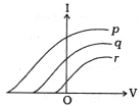
- B
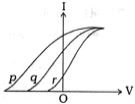
- C
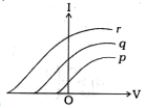
- D
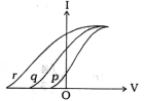
Explore More
Similar Questions
The kinetic energy of emitted cathode rays is dependent on:
Easy
View SolutionAssertion: The specific charge of positive rays is not constant.
Reason: The mass of ions varies with speed.
Reason: The mass of ions varies with speed.
An electromagnetic wave of wavelength $\lambda$ is incident on a photosensitive surface of negligible work function. If the photoelectrons emitted from this surface have the de-Broglie wavelength $\lambda_{1}$,then:
What phenomena of light can be explained on the basis of particle theory and wave theory of light?
Medium
View SolutionIn a photoelectric experiment,light of wavelength $800 \ nm$ produces photoelectrons with the smallest de Broglie wavelength of $1 \ nm$. Then the work function of the metal used in the experiment is nearly (in $eV$)
Vedclass Products
For Students
Vedclass Test Series
Mock tests in real JEE/NEET style with performance analysis. 5-day free trial.
Start Free TrialFor Teachers
Exam Paper Generator
Generate Set A/B/C/D exam papers from 7.5L+ questions in 2 minutes. 3 chapters free.
Try FreeFor Institutes
Online Exam Module
Live online exams with unlimited students, 360° analytics & white-label branding.
See Demo