
Class 11PhysicsSystem of Particles and Rotational MotionMix Example - System of Particles and Rotational Motion
MediumThe graph between $\log_e L$ and $\log_e P$ will be (where $L$ is angular momentum and $P$ is linear momentum):
- A
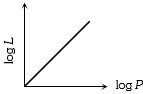
- B
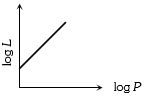
- C
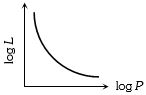
- D
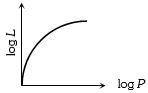
Explore More
Similar Questions
One of two identical cylinders,cylinder $A$,rotates at an angular speed of $50 \text{ revolutions per second}$. This rotating cylinder is brought into contact with a second stationary cylinder,$B$. Due to kinetic friction between the two cylinders,the stationary cylinder starts rotating with an angular acceleration,while cylinder $A$ undergoes angular deceleration. If the magnitude of the angular acceleration for both cylinders is $1 \text{ revolution per second}^2$,after how many seconds $(t)$ will the angular speeds of both cylinders become equal?
Difficult
View Solution$A$ yo-yo is resting on a rough horizontal table. Forces $F_1, F_2$ and $F_3$ are applied separately as shown. The correct statement is
Difficult
View Solution$A$ ring and a disc have the same mass and the same radius. The ratio of the moment of inertia of a ring about a tangent in its plane to that of the disc about its diameter is: (in $: 1$)
The figure shows a system consisting of $(i)$ a ring of outer radius $3R$ rolling clockwise without slipping on a horizontal surface with angular speed $\omega$ and $(ii)$ an inner disc of radius $2R$ rotating anti-clockwise with angular speed $\omega/2$. The ring and disc are separated by frictionless ball bearings. The system is in the $x-z$ plane. The point $P$ on the inner disc is at distance $R$ from the origin,where $OP$ makes an angle of $30^{\circ}$ with the horizontal. Then with respect to the horizontal surface,
$(A)$ the point $O$ has linear velocity $3R\omega\hat{i}$.
$(B)$ the point $P$ has a linear velocity $\frac{11}{4}R\omega\hat{i} + \frac{\sqrt{3}}{4}R\omega\hat{k}$.
$(C)$ the point $P$ has linear velocity $\frac{13}{4}R\omega\hat{i} - \frac{\sqrt{3}}{4}R\omega\hat{k}$.
$(D)$ The point $P$ has a linear velocity $(3 - \frac{\sqrt{3}}{4})R\omega\hat{i} + \frac{1}{4}R\omega\hat{k}$.
$(A)$ the point $O$ has linear velocity $3R\omega\hat{i}$.
$(B)$ the point $P$ has a linear velocity $\frac{11}{4}R\omega\hat{i} + \frac{\sqrt{3}}{4}R\omega\hat{k}$.
$(C)$ the point $P$ has linear velocity $\frac{13}{4}R\omega\hat{i} - \frac{\sqrt{3}}{4}R\omega\hat{k}$.
$(D)$ The point $P$ has a linear velocity $(3 - \frac{\sqrt{3}}{4})R\omega\hat{i} + \frac{1}{4}R\omega\hat{k}$.
According to the parallel axis theorem,$I = I_{cm} + Mx^2$. What will be the graph between $I$ and $x$?
Medium
View SolutionVedclass Products
For Students
Vedclass Test Series
Mock tests in real JEE/NEET style with performance analysis. 5-day free trial.
Start Free TrialFor Teachers
Exam Paper Generator
Generate Set A/B/C/D exam papers from 7.5L+ questions in 2 minutes. 3 chapters free.
Try FreeFor Institutes
Online Exam Module
Live online exams with unlimited students, 360° analytics & white-label branding.
See Demo