
Class 11PhysicsNewton's Laws of Motion and FrictionMix Examples-Newton's Laws of Motion and Friction
Difficult$A$ block $B$ is placed on block $A$. The mass of block $B$ is less than the mass of block $A$. Friction exists between the blocks,whereas the ground on which the block $A$ is placed is taken to be smooth. $A$ horizontal force $F$,increasing linearly with time,begins to act on $B$. The acceleration $a_A$ and $a_B$ of blocks $A$ and $B$ respectively are plotted against $t$. The correctly plotted graph is
- A
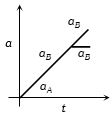
- B
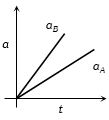
- C
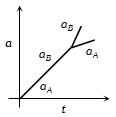
- D
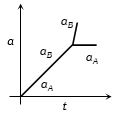
Explore More
Similar Questions
$A$ sphere of mass $m$ and radius $R$ is kept on a rough horizontal surface and pulled with a horizontal force $F = \alpha t$,where $\alpha$ is a constant and $t$ is time. The coefficient of static friction is $\mu_s$ and the coefficient of kinetic friction is $\mu_k$. Which of the following graphs correctly shows the variation of the acceleration of the sphere with time?
Place a uniform meter scale horizontally on your extended index fingers with the left one at $0.00 \ cm$ and the right one at $90.00 \ cm$. When you attempt to move both fingers slowly towards the center,initially only the left finger slips with respect to the scale and the right finger does not. After some distance,the left finger stops and the right one starts slipping. Then the right finger stops at a distance $x_R$ from the center $(50.00 \ cm)$ of the scale and the left one starts slipping again. This happens because of the difference in the frictional forces on the two fingers. If the coefficients of static and dynamic friction between the fingers and the scale are $0.40$ and $0.32$,respectively,the value of $x_R$ (in $cm$) is:
For the given system,which of the following relations holds between $T_1$,$T_2$,and $T_3$?
Easy
View SolutionFill in the blanks:
$(a)$ If a force of $10\, N$ is applied to an object and it produces an acceleration of $1\, m s^{-2}$,then the mass of the object is ...
$(b)$ According to Newton's first law of motion,no force is required to keep an object moving with ......... velocity.
$(c)$ The apparent weight of an object in a lift accelerating upwards is ......... .
$(a)$ If a force of $10\, N$ is applied to an object and it produces an acceleration of $1\, m s^{-2}$,then the mass of the object is ...
$(b)$ According to Newton's first law of motion,no force is required to keep an object moving with ......... velocity.
$(c)$ The apparent weight of an object in a lift accelerating upwards is ......... .
Medium
View Solution$A$ bird is sitting in a large closed cage which is placed on a spring balance. It records a weight of $25 \, N$. The bird (mass $m = 0.5 \, kg$) flies upward in the cage with an acceleration of $2 \, m/s^2$. The spring balance will now record a weight of ........ $N$.
Medium
View SolutionVedclass Products
For Students
Vedclass Test Series
Mock tests in real JEE/NEET style with performance analysis. 5-day free trial.
Start Free TrialFor Teachers
Exam Paper Generator
Generate Set A/B/C/D exam papers from 7.5L+ questions in 2 minutes. 3 chapters free.
Try FreeFor Institutes
Online Exam Module
Live online exams with unlimited students, 360° analytics & white-label branding.
See Demo