
Medium
$A$ capillary tube $(A)$ is dipped in water. Another identical tube $(B)$ is dipped in a soap-water solution. Which of the following shows the relative nature of the liquid columns in the two tubes?
- A
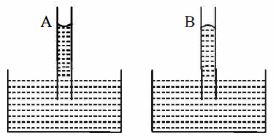
- B
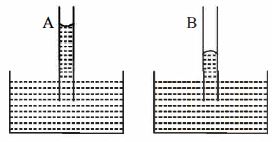
- C
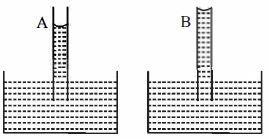
- D
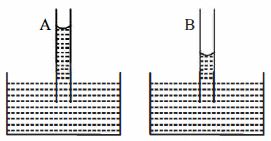
Explore More
Similar Questions
$A$ motor is used to deliver water at a certain rate through a given horizontal pipe. To deliver $n$-times the water through the same pipe in the same time, the power of the motor must be increased as follows:
DifficultAP EAMCET 2006
View Solution$A$ cylindrical vessel containing a liquid is rotated about its axis so that the liquid rises at its sides as shown in the figure. The diameter of the vessel is $10 \, cm$ and the angular speed of rotation is $\omega \, rad \, s^{-1}$. The difference in the height,$h$ (in $cm$),of the liquid at the centre of the vessel and at the side will be
DifficultJEE MAIN 2020
View Solution$A$ cylindrical capillary tube of $0.2 \ mm$ radius is made by joining two capillaries $T_1$ and $T_2$ of different materials having water contact angles of $0^{\circ}$ and $60^{\circ}$,respectively. The capillary tube is dipped vertically in water in two different configurations,case $I$ and $II$ as shown in the figure. Which of the following option$(s)$ is(are) correct?
(Surface tension of water $= 0.075 \ N/m$,density of water $= 1000 \ kg/m^3$,take $g = 10 \ m/s^2$)
$(1)$ The correction in the height of the water column raised in the tube,due to the weight of water contained in the meniscus,will be different for both cases.
$(2)$ For case $I$,if the capillary joint is $5 \ cm$ above the water surface,the height of the water column raised in the tube will be more than $8.75 \ cm$. (Neglect the weight of the water in the meniscus)
$(3)$ For case $I$,if the joint is kept at $8 \ cm$ above the water surface,the height of the water column in the tube will be $7.5 \ cm$. (Neglect the weight of the water in the meniscus)
$(4)$ For case $II$,if the capillary joint is $5 \ cm$ above the water surface,the height of the water column raised in the tube will be $3.75 \ cm$. (Neglect the weight of the water in the meniscus)
(Surface tension of water $= 0.075 \ N/m$,density of water $= 1000 \ kg/m^3$,take $g = 10 \ m/s^2$)
$(1)$ The correction in the height of the water column raised in the tube,due to the weight of water contained in the meniscus,will be different for both cases.
$(2)$ For case $I$,if the capillary joint is $5 \ cm$ above the water surface,the height of the water column raised in the tube will be more than $8.75 \ cm$. (Neglect the weight of the water in the meniscus)
$(3)$ For case $I$,if the joint is kept at $8 \ cm$ above the water surface,the height of the water column in the tube will be $7.5 \ cm$. (Neglect the weight of the water in the meniscus)
$(4)$ For case $II$,if the capillary joint is $5 \ cm$ above the water surface,the height of the water column raised in the tube will be $3.75 \ cm$. (Neglect the weight of the water in the meniscus)
DifficultIIT 2019
View Solution$A$ tank with a square base of area $1.0 \; m^{2}$ is divided by a vertical partition in the middle. The bottom of the partition has a small hinged door of area $20 \; cm^{2}$. The tank is filled with water in one compartment and an acid (of relative density $1.7$) in the other,both to a height of $4.0 \; m$. Compute the force (in $N$) necessary to keep the door closed.
Medium
View SolutionTwo cylindrical vessels of equal cross-sectional area $16\,cm^{2}$ contain water up to heights $100\,cm$ and $150\,cm$ respectively. The vessels are interconnected so that the water levels in them become equal. The work done by the force of gravity during the process is $......J$. [Take density of water $= 10^{3}\,kg/m^{3}$ and $g = 10\,m/s^{2}$]
DifficultJEE MAIN 2022
View SolutionVedclass Products
For Students
Vedclass Test Series
Mock tests in real JEE/NEET style with performance analysis. 5-day free trial.
Start Free TrialFor Teachers
Exam Paper Generator
Generate Set A/B/C/D exam papers from 7.5L+ questions in 2 minutes. 3 chapters free.
Try FreeFor Institutes
Online Exam Module
Live online exams with unlimited students, 360° analytics & white-label branding.
See Demo