
$A$ copper rod and a steel rod of equal cross-sections and lengths $L$ are joined side by side and connected between two heat baths as shown in the figure. If heat flows through them from $x = 0$ to $x = 2L$ at a steady rate and thermal conductivities of the metals are $K_{Cu}$ and $K_{Steel}$ $(K_{Cu} > K_{Steel})$,then the temperature varies as (convection and radiation are negligible):
- A
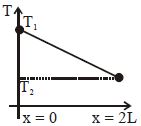
- B
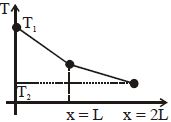
- C
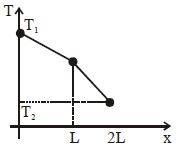
- D
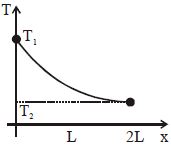
Explore More
Similar Questions
The ratio of the thermal conductivity of two rods of different materials is $6:5$. The two rods of same area of cross section and same thermal resistance will have the lengths in the ratio:
The thermal conductivity of a rod is $2$. What is its thermal resistivity?
DifficultMHT CET 2007
View SolutionThe temperature difference across two cylindrical rods $A$ and $B$ of the same material and same mass are $40^{\circ} C$ and $60^{\circ} C$ respectively. In steady state,if the rates of flow of heat through the rods $A$ and $B$ are in the ratio $3: 8$,the ratio of the lengths of the rods $A$ and $B$ is (in $: 3$)
If the ratio of the coefficient of thermal conductivity of silver and copper is $10 : 9$,then the ratio of the lengths up to which wax will melt in the Ingen Hausz experiment will be:
Medium
View Solution$A$ cylindrical rod has temperatures $T_1$ and $T_2$ at its ends. The rate of flow of heat is $Q_1 \ cal/sec$. If all the linear dimensions are doubled while keeping the temperatures constant,then the new rate of flow of heat $Q_2$ will be:
MediumAIPMT 2001
View SolutionVedclass Products
For Students
Vedclass Test Series
Mock tests in real JEE/NEET style with performance analysis. 5-day free trial.
Start Free TrialFor Teachers
Exam Paper Generator
Generate Set A/B/C/D exam papers from 7.5L+ questions in 2 minutes. 3 chapters free.
Try FreeFor Institutes
Online Exam Module
Live online exams with unlimited students, 360° analytics & white-label branding.
See Demo