
Medium
$A$ lead shot of $1 \, mm$ diameter falls through a long column of glycerine. The variation of its velocity $v$ with distance covered is represented by:
- A
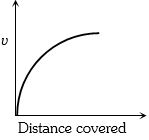
- B
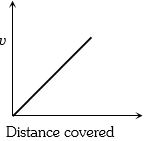
- C
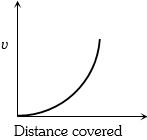
- D
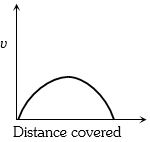
Explore More
Similar Questions
Two spheres of the same material, but of radii $R$ and $3R$ are allowed to fall vertically downwards through a liquid of density $\rho$. The ratio of their terminal velocities is
$A$ small spherical ball of radius $0.1 \,mm$ and density $10^{4} \,kg \,m^{-3}$ falls freely under gravity through a distance $h$ before entering a tank of water. If after entering the water the velocity of the ball does not change and it continues to fall with the same constant velocity inside the water,then the value of $h$ will be $m$. (Given $g = 10 \,m \,s^{-2}$,viscosity of water $\eta = 1.0 \times 10^{-5} \,N \,s \,m^{-2}$,density of water $\rho_w = 10^3 \,kg \,m^{-3}$)
DifficultJEE MAIN 2022
View Solution$125$ small water drops of same size fall through air with constant terminal velocity $4 \,cm/s$. They coalesce to form a big drop. The terminal velocity of the big drop is: (in $\,m/s$)
$A$ small spherical solid ball is dropped in a viscous liquid. Its journey in the liquid is best described by which curve in the figure?
Medium
View Solution$A$ small spherical solid ball is dropped from a great height in a viscous liquid. Its journey in the liquid is best described in the diagram given below by the
Easy
View SolutionVedclass Products
For Students
Vedclass Test Series
Mock tests in real JEE/NEET style with performance analysis. 5-day free trial.
Start Free TrialFor Teachers
Exam Paper Generator
Generate Set A/B/C/D exam papers from 7.5L+ questions in 2 minutes. 3 chapters free.
Try FreeFor Institutes
Online Exam Module
Live online exams with unlimited students, 360° analytics & white-label branding.
See Demo