
$A$ particle of mass $m$ moves in a circular orbit under the central potential field,$U(r) = -\frac{C}{r}$,where $C$ is a positive constant. The correct radius-velocity graph of the particle's motion is:
- A
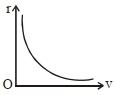
- B
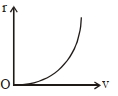
- C
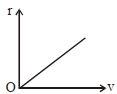
- D
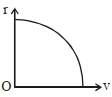
Explore More
Similar Questions
The variation of acceleration due to gravity $g$ with distance $d$ from the centre of the earth is best represented by ($R =$ Earth's radius)
If two bodies $A$ and $B$ of equal masses $M$ are situated in air at a distance $d$ and the gravitational force between them is $F$. Now,$50 \%$ of the mass is transferred from body $A$ to $B$ and the distance between them is reduced to $\frac{d}{2}$. If the space around them is now filled with a liquid of specific density $3$,what will be the new gravitational force?
Difficult
View Solution$A$ body situated on the surface of the earth becomes weightless at the equator when the rotational kinetic energy of the earth reaches a critical value '$K$'. The value of '$K$' is given by [$g$ = gravitational acceleration on earth's surface,$M$ = mass of the earth,and $R$ = radius of the earth].
DifficultMHT CET 2021
View SolutionThe figure shows the orbit of a planet $P$ around the sun $S.$ $AB$ and $CD$ are the minor and major axes of the ellipse,respectively. If $U$ is the potential energy and $K$ is the kinetic energy of the planet,then $|U| > |K|$ at:
Medium
View SolutionThe relative uncertainty in the period of a satellite orbiting around the Earth is $10^{-2}$. If the relative uncertainty in the radius of the orbit is negligible,the relative uncertainty in the mass of the Earth is:
Vedclass Products
For Students
Vedclass Test Series
Mock tests in real JEE/NEET style with performance analysis. 5-day free trial.
Start Free TrialFor Teachers
Exam Paper Generator
Generate Set A/B/C/D exam papers from 7.5L+ questions in 2 minutes. 3 chapters free.
Try FreeFor Institutes
Online Exam Module
Live online exams with unlimited students, 360° analytics & white-label branding.
See Demo