
$A$ quantity is measured repeatedly many times with an instrument. The readings are shown in the figures where $T$ represents the true value of the measurement. Which of the following measurements is imprecise but accurate?
- A
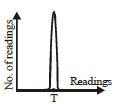
- B
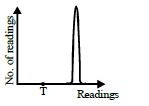
- C
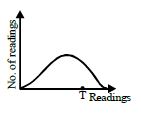
- D
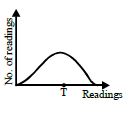
Explore More
Similar Questions
$A$ metal wire has mass $(0.4 \pm 0.002) \, g$,radius $(0.3 \pm 0.001) \, mm$ and length $(5 \pm 0.02) \, cm$. The maximum possible percentage error in the measurement of density will nearly be $.......\%$
The percentage error in the measurement of mass and speed of a particular body is $3 \%$ and $4 \%$ respectively. The percentage error in the measurement of kinetic energy is (in $\%$)
Time intervals measured by a clock give the following readings: $1.25 \; s, 1.24 \; s, 1.27 \; s, 1.21 \; s$,and $1.28 \; s$. What is the percentage relative error of the observations?
MediumNEET 2020
View SolutionWhat is least count? What is called least count error?
Medium
View SolutionThe maximum percentage error in the measurement of the density of a wire is: [Given: mass of wire $= (0.60 \pm 0.003) \ g$,radius of wire $= (0.50 \pm 0.01) \ cm$,length of wire $= (10.00 \pm 0.05) \ cm$]
Vedclass Products
For Students
Vedclass Test Series
Mock tests in real JEE/NEET style with performance analysis. 5-day free trial.
Start Free TrialFor Teachers
Exam Paper Generator
Generate Set A/B/C/D exam papers from 7.5L+ questions in 2 minutes. 3 chapters free.
Try FreeFor Institutes
Online Exam Module
Live online exams with unlimited students, 360° analytics & white-label branding.
See Demo