
$A$ tennis ball is dropped on a horizontal smooth surface. It bounces back to its original position after hitting the surface. The force on the ball during the collision is proportional to the length of compression of the ball. Which one of the following sketches describes the variation of its kinetic energy $K$ with time $t$ most appropriately? The figures are only illustrative and not to the scale.
- A
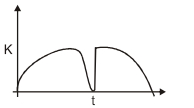
- B
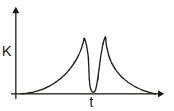
- C
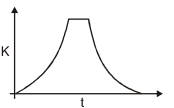
- D
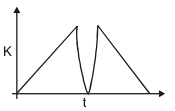
Explore More
Similar Questions
State whether the following statements are true or false:
$(a)$ Power is the vector product of force and velocity.
$(b)$ $1\,kg\,m = 9.8\,J$
$(c)$ When a teacher rubs a blackboard with a duster,they do no work.
$(d)$ Kinetic energy can be negative.
$(a)$ Power is the vector product of force and velocity.
$(b)$ $1\,kg\,m = 9.8\,J$
$(c)$ When a teacher rubs a blackboard with a duster,they do no work.
$(d)$ Kinetic energy can be negative.
Medium
View Solution$A$ body of mass $m_1$ moving with an unknown velocity $v_1 \hat{i}$ undergoes a one-dimensional collision with a body of mass $m_2$ moving with velocity $v_2 \hat{i}$. After the collision,the bodies $m_1$ and $m_2$ move with velocities $v_3 \hat{i}$ and $v_4 \hat{i}$ respectively. If $m_2 = 0.5\, m_1$ and $v_3 = 0.5\, v_1$,find $v_1$.
$A$ ball is released from a certain height. It loses $50\%$ of its kinetic energy on striking the ground. It will attain a height again equal to
Medium
View Solution$A$ student skates up a ramp that makes an angle $30^{\circ}$ with the horizontal. He/she starts (as shown in the figure) at the bottom of the ramp with speed $v_0$ and wants to turn around over a semicircular path $xyz$ of radius $R$ during which he/she reaches a maximum height $h$ (at point $y$) from the ground as shown in the figure. Assume that the energy loss is negligible and the force required for this turn at the highest point is provided by his/her weight only. Then ($g$ is the acceleration due to gravity):
$(A)$ $v_0^2 - 2gh = \frac{1}{2} gR$
$(B)$ $v_0^2 - 2gh = \frac{\sqrt{3}}{2} gR$
$(C)$ The centripetal force required at points $x$ and $z$ is zero.
$(D)$ The centripetal force required is maximum at points $x$ and $z$.
$(A)$ $v_0^2 - 2gh = \frac{1}{2} gR$
$(B)$ $v_0^2 - 2gh = \frac{\sqrt{3}}{2} gR$
$(C)$ The centripetal force required at points $x$ and $z$ is zero.
$(D)$ The centripetal force required is maximum at points $x$ and $z$.
The position $x$ of a particle moving along the $x$-axis at time $t$ is given by the equation $t = \sqrt{x} + 2$,where $x$ is in metres and $t$ is in seconds. The work done by the force in the first $4 \ s$ is .............. $J$.
Medium
View SolutionVedclass Products
For Students
Vedclass Test Series
Mock tests in real JEE/NEET style with performance analysis. 5-day free trial.
Start Free TrialFor Teachers
Exam Paper Generator
Generate Set A/B/C/D exam papers from 7.5L+ questions in 2 minutes. 3 chapters free.
Try FreeFor Institutes
Online Exam Module
Live online exams with unlimited students, 360° analytics & white-label branding.
See Demo