
Class 12PhysicsDual Nature of Radiation and matterEinstein's Photoelectric Equation and Energy Quantum of Radiation
EasyAccording to Einstein's photoelectric equation,the graph between the kinetic energy of photoelectrons ejected and the frequency of incident radiation is
- A
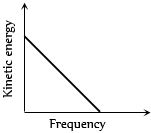
- B
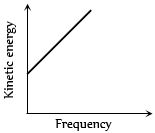
- C
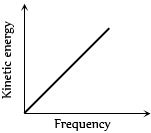
- D
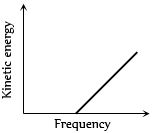
Explore More
Similar Questions
The work function of caesium is $2.14 \ eV$. Find
$(a)$ the threshold frequency for caesium,and
$(b)$ the wavelength of the incident light if the photocurrent is brought to zero by a stopping potential of $0.60 \ V$.
$(a)$ the threshold frequency for caesium,and
$(b)$ the wavelength of the incident light if the photocurrent is brought to zero by a stopping potential of $0.60 \ V$.
Medium
View Solution$A$ photon of energy $8 eV$ is incident on a metal surface of threshold frequency $1.6 \times 10^{15} Hz$. The maximum kinetic energy of the emitted photoelectrons is ............... $eV$ (Given $h = 6.6 \times 10^{-34} Js$).
Medium
View SolutionIf the work function for a certain metal is $3.2 \times 10^{-19} \ J$ and it is illuminated with light of frequency $8 \times 10^{14} \ Hz$,the maximum kinetic energy of the photo-electrons would be (given $h = 6.63 \times 10^{-34} \ J \cdot s$):
Medium
View SolutionSodium and copper have work functions $2.3 \ eV$ and $4.5 \ eV$ respectively. Then the ratio of their threshold wavelengths is nearest to
The figure represents a graph of the maximum kinetic energy $(K)$ of photoelectrons (in $eV$) versus the frequency $(\nu)$ of incident radiation for a metal used as a cathode in a photoelectric experiment. The work function of the metal is ............. $eV$.
Easy
View SolutionVedclass Products
For Students
Vedclass Test Series
Mock tests in real JEE/NEET style with performance analysis. 5-day free trial.
Start Free TrialFor Teachers
Exam Paper Generator
Generate Set A/B/C/D exam papers from 7.5L+ questions in 2 minutes. 3 chapters free.
Try FreeFor Institutes
Online Exam Module
Live online exams with unlimited students, 360° analytics & white-label branding.
See Demo