
An ideal gas follows a process $PT = \text{constant}$. The correct graph between pressure $P$ and volume $V$ is:
- A
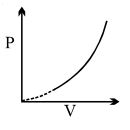
- B
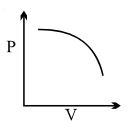
- C
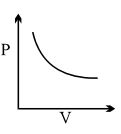
- D
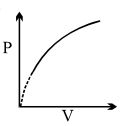
Explore More
Similar Questions
The internal energy of an ideal diatomic gas corresponding to volume $V$ and pressure $P$ is $2.5 PV$. The gas expands from $1 \text{ litre}$ to $2 \text{ litre}$ at a constant pressure of $10^5 \text{ N/m}^2$. The heat supplied to the gas is: (in $\text{ J}$)
Two cylinders $A$ and $B$ fitted with pistons contain an equal amount of an ideal diatomic gas at temperature $T$ $K$. The piston of cylinder $A$ is free to move,while that of $B$ is held fixed. The same amount of heat is given to the gas in each cylinder. If the rise in temperature of the gas in $A$ is $dT_{A}$,then the rise in temperature of the gas in cylinder $B$ is (where $\gamma = \frac{C_{P}}{C_{V}}$):
DifficultMHT CET 2024
View Solution$List-I$ describes thermodynamic processes in four different systems. $List-II$ gives the magnitudes (either exactly or as a close approximation) of possible changes in the internal energy of the system due to the process.
$List-I$ $List-II$ $(I)$ $10^{-3} \, kg$ of water at $100^{\circ} C$ is converted to steam at the same temperature, at a pressure of $10^5 \, Pa$. The volume of the system changes from $10^{-6} \, m^3$ to $10^{-3} \, m^3$. Latent heat of water $= 2250 \, kJ/kg$. $(P)$ $2 \, kJ$ $(II)$ $0.2 \, moles$ of a rigid diatomic ideal gas with volume $V$ at temperature $500 \, K$ undergoes an isobaric expansion to volume $3V$. Assume $R = 8.0 \, J \, mol^{-1} \, K^{-1}$. $(Q)$ $7 \, kJ$ $(III)$ One mole of a monatomic ideal gas is compressed adiabatically from volume $V = 1/3 \, m^3$ and pressure $2 \, kPa$ to volume $V/8$. $(R)$ $4 \, kJ$ $(IV)$ Three moles of a diatomic ideal gas whose molecules can vibrate, is given $9 \, kJ$ of heat and undergoes isobaric expansion. $(S)$ $5 \, kJ$ $(T)$ $3 \, kJ$
Which one of the following options is correct?
| $List-I$ | $List-II$ |
| $(I)$ $10^{-3} \, kg$ of water at $100^{\circ} C$ is converted to steam at the same temperature, at a pressure of $10^5 \, Pa$. The volume of the system changes from $10^{-6} \, m^3$ to $10^{-3} \, m^3$. Latent heat of water $= 2250 \, kJ/kg$. | $(P)$ $2 \, kJ$ |
| $(II)$ $0.2 \, moles$ of a rigid diatomic ideal gas with volume $V$ at temperature $500 \, K$ undergoes an isobaric expansion to volume $3V$. Assume $R = 8.0 \, J \, mol^{-1} \, K^{-1}$. | $(Q)$ $7 \, kJ$ |
| $(III)$ One mole of a monatomic ideal gas is compressed adiabatically from volume $V = 1/3 \, m^3$ and pressure $2 \, kPa$ to volume $V/8$. | $(R)$ $4 \, kJ$ |
| $(IV)$ Three moles of a diatomic ideal gas whose molecules can vibrate, is given $9 \, kJ$ of heat and undergoes isobaric expansion. | $(S)$ $5 \, kJ$ |
| $(T)$ $3 \, kJ$ |
Which one of the following options is correct?
$A$ heating element of resistance $r$ is fitted inside an adiabatic cylinder which carries a frictionless piston of mass $m$ and cross-sectional area $A$. The cylinder contains one mole of a diatomic gas. The temperature of the gas varies with time $t$ as $T = \alpha t + \frac{1}{2} \beta t^2$ (where $\alpha$ and $\beta$ are constants), while the pressure remains constant. The atmospheric pressure above the piston is $P_0$. Then:
DifficultWBJEE 2014
View SolutionTwo samples $A$ and $B$ of a gas,initially at the same pressure and temperature,are compressed from volume $V$ to $V/2$. Sample $A$ is compressed isothermally,and sample $B$ is compressed adiabatically. The final pressure of $A$ is:
Medium
View SolutionVedclass Products
For Students
Vedclass Test Series
Mock tests in real JEE/NEET style with performance analysis. 5-day free trial.
Start Free TrialFor Teachers
Exam Paper Generator
Generate Set A/B/C/D exam papers from 7.5L+ questions in 2 minutes. 3 chapters free.
Try FreeFor Institutes
Online Exam Module
Live online exams with unlimited students, 360° analytics & white-label branding.
See Demo