
Class 11PhysicsKinetic Theory of GasesGas Laws (Charles, Boyle's, Avagadro's, Gay Lussacs and Dalton's law) and Ideal gas Equation
DifficultAn ideal gas is initially at temperature $T$ and volume $V.$ Its volume is increased by $\Delta V$ due to an increase in temperature $\Delta T,$ pressure remaining constant. The quantity $\delta = \Delta V / (V \Delta T)$ varies with temperature as
- A
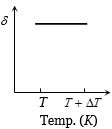
- B
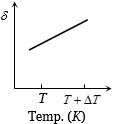
- C
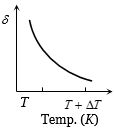
- D
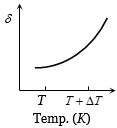
Explore More
Similar Questions
An ideal gas initially at pressure $1 \, bar$ is being compressed from $30 \, m^{3}$ to $10 \, m^{3}$ volume and its temperature decreases from $320 \, K$ to $280 \, K$. Find the final pressure of the gas (in $bar$).
MediumAIIMS 2019
View Solution$A$ pressure $P-$absolute temperature $T$ diagram was obtained when a given mass of gas was heated. During the heating process from state $1$ to state $2$,the volume:
Difficult
View SolutionThe gas law $\frac{PV}{T} = \text{constant}$ is true for
Easy
View SolutionAn ideal gas has an initial pressure of $3$ pressure units and an initial volume of $4$ volume units. The table gives the final pressure and volume of the gas (in those same units) in four processes. Which processes start and end on the same isotherm?
$A$. Process $A$ $P=5, V=7$ $B$. Process $B$ $P=4, V=6$ $C$. Process $C$ $P=12, V=1$ $D$. Process $D$ $P=6, V=3$
| $A$. Process $A$ | $P=5, V=7$ |
| $B$. Process $B$ | $P=4, V=6$ |
| $C$. Process $C$ | $P=12, V=1$ |
| $D$. Process $D$ | $P=6, V=3$ |
Easy
View SolutionTwo different masses $m$ and $3m$ of an ideal gas are heated separately in a vessel of constant volume. The pressure $P$ versus absolute temperature $T$ graphs for these two cases are shown in the figure. The ratio of the slopes of curves $B$ to $A$ is
Medium
View SolutionVedclass Products
For Students
Vedclass Test Series
Mock tests in real JEE/NEET style with performance analysis. 5-day free trial.
Start Free TrialFor Teachers
Exam Paper Generator
Generate Set A/B/C/D exam papers from 7.5L+ questions in 2 minutes. 3 chapters free.
Try FreeFor Institutes
Online Exam Module
Live online exams with unlimited students, 360° analytics & white-label branding.
See Demo