
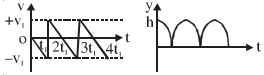
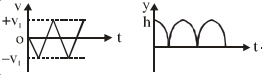
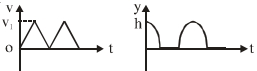
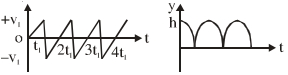
Consider a rubber ball freely falling from a height $h = 4.9 \ m$ onto a horizontal elastic plate. Assume that the duration of collision is negligible and the collision with the plate is totally elastic. Then the velocity as a function of time and the height as a function of time will be represented by which of the following graphs?
- A
- B
- C
- D
Explore More
Similar Questions
Draw the graph of $y$ versus $t$ for an object falling freely,where $y$ is the vertical displacement and $t$ is time.
Easy
View SolutionTwo stones begin to fall from rest from the same height,with the second stone starting to fall $\Delta t$ seconds after the first. The distance of separation between the two stones becomes $H$,$t_0$ seconds after the first stone starts its motion. Then $t_0$ is equal to:
MediumKCET 2025
View Solution$A$ body is projected vertically upward from the surface of the Earth. If the upward direction is taken as positive,then the acceleration of the body during its upward and downward journey are respectively:
Easy
View SolutionAssertion: The zero velocity of a particle at any instant always implies zero acceleration at that instant.
Reason: $A$ body is momentarily at rest when it reverses its direction of motion.
The correct option among the following is:
Reason: $A$ body is momentarily at rest when it reverses its direction of motion.
The correct option among the following is:
From $18 \text{ m}$ height above the ground, a ball is dropped from rest. The height above the ground at which the magnitude of velocity equals the magnitude of acceleration (in the same set of units) due to gravity is . . . . . . $\text{m}$. (Take $g = 10 \text{ m/s}^2$ and neglect the air resistance)
DifficultJEE MAIN 2026
View SolutionVedclass Products
For Students
Vedclass Test Series
Mock tests in real JEE/NEET style with performance analysis. 5-day free trial.
Start Free TrialFor Teachers
Exam Paper Generator
Generate Set A/B/C/D exam papers from 7.5L+ questions in 2 minutes. 3 chapters free.
Try FreeFor Institutes
Online Exam Module
Live online exams with unlimited students, 360° analytics & white-label branding.
See Demo