
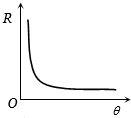
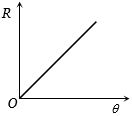
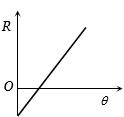
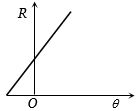
For a small temperature difference between the body and the surroundings,the relation between the rate of loss of heat $R$ and the temperature of the body $\theta$ is depicted by:
- A
- B
- C
- D
Explore More
Similar Questions
$A$ body cools from $50.0^{\circ}C$ to $49.9^{\circ}C$ in $5\;s$. How long will it take to cool from $40.0^{\circ}C$ to $39.9^{\circ}C$? Assume the temperature of surroundings to be $30.0^{\circ}C$ and Newton's law of cooling to be valid. The time taken is ....... $s$.
Medium
View Solution$A$ system $S$ receives heat continuously from an electrical heater of power $10 \ W$. The temperature of $S$ becomes constant at $50^{\circ}C$ when the surrounding temperature is $20^{\circ}C$. After the heater is switched off, $S$ cools from $35.1^{\circ}C$ to $34.9^{\circ}C$ in $1 \ minute$. The heat capacity of $S$ is........ $J/^{\circ}C$.
Difficult
View SolutionHot water cools from $60^{\circ} C$ to $50^{\circ} C$ in the first $10 \ min$ and to $42^{\circ} C$ in the next $10 \ min$. Then the temperature of the surroundings is (in $^{\circ} C$)
$A$ suspended sphere has density $d$ and specific heat $s$. The radius of the sphere is $r$. The temperature difference between the sphere and the surroundings $(\Delta \theta)$ is very small. If the temperature of the surroundings is $\theta_0$,then the rate of cooling of the sphere will be .......
Difficult
View SolutionTwo hot bodies $A$ and $B$ have temperatures $100^{\circ}C$ and $80^{\circ}C$ respectively. The surrounding temperature is $40^{\circ}C$. The ratio of their rates of cooling $R_1 : R_2$ at $t = 0$ is:
Medium
View SolutionVedclass Products
For Students
Vedclass Test Series
Mock tests in real JEE/NEET style with performance analysis. 5-day free trial.
Start Free TrialFor Teachers
Exam Paper Generator
Generate Set A/B/C/D exam papers from 7.5L+ questions in 2 minutes. 3 chapters free.
Try FreeFor Institutes
Online Exam Module
Live online exams with unlimited students, 360° analytics & white-label branding.
See Demo