
Identify the major products $(P)$ and $(Q)$ respectively for the given reaction.
- A
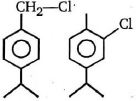
- B
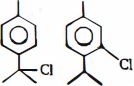
- C
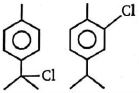
- D
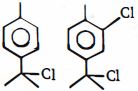
Explore More
Similar Questions
Arrange the following reactants in increasing order of reactivity towards $S_{N^1}$ solvolysis reaction with methanol.
Difficult
View SolutionConsider the above sequence of reactions. $151 \ g$ of $2-$bromopentane is made to react. The yield of the major product $P$ is $80 \%$ whereas the yield of $Q$ is $100 \%$. The mass of product $Q$ obtained is $........ \ g$. (Given molar mass in $g \ mol^{-1}$: $H: 1, C: 12, Br: 80$)
Match List-$I$ with List-$II$:
List-$I$ List-$II$ $a$. Benzenediazonium chloride $\xrightarrow{Cu_2Cl_2/HCl}$ Chlorobenzene $+ N_2$ $i$. Wurtz reaction $b$. Benzenediazonium chloride $\xrightarrow{Cu/HCl}$ Chlorobenzene $+ N_2$ $ii$. Sandmeyer reaction $c$. $2 CH_3CH_2Cl + 2 Na \xrightarrow{Ether} C_2H_5-C_2H_5 + 2 NaCl$ $iii$. Fittig reaction $d$. $2 C_6H_5Cl + 2 Na \xrightarrow{Ether} C_6H_5-C_6H_5 + 2 NaCl$ $iv$. Gatterman reaction
Choose the correct answer from the options given below:
| List-$I$ | List-$II$ |
|---|---|
| $a$. Benzenediazonium chloride $\xrightarrow{Cu_2Cl_2/HCl}$ Chlorobenzene $+ N_2$ | $i$. Wurtz reaction |
| $b$. Benzenediazonium chloride $\xrightarrow{Cu/HCl}$ Chlorobenzene $+ N_2$ | $ii$. Sandmeyer reaction |
| $c$. $2 CH_3CH_2Cl + 2 Na \xrightarrow{Ether} C_2H_5-C_2H_5 + 2 NaCl$ | $iii$. Fittig reaction |
| $d$. $2 C_6H_5Cl + 2 Na \xrightarrow{Ether} C_6H_5-C_6H_5 + 2 NaCl$ | $iv$. Gatterman reaction |
Choose the correct answer from the options given below:
Complete the following reactions:
$(1)$ $1$-Chloropropane $\xrightarrow[{KOH}]{{\text{ethanol}}} (B)$ $\xrightarrow[{CCl_4}]{{Br_2}} (C)$
$(2)$ Ethane $\xrightarrow[{hv}]{{Cl_2}} (B)$ $\xrightarrow[{Na, \text{ether}}]{} (C)$
$(1)$ $1$-Chloropropane $\xrightarrow[{KOH}]{{\text{ethanol}}} (B)$ $\xrightarrow[{CCl_4}]{{Br_2}} (C)$
$(2)$ Ethane $\xrightarrow[{hv}]{{Cl_2}} (B)$ $\xrightarrow[{Na, \text{ether}}]{} (C)$
Medium
View SolutionWhich of the following cannot undergo nucleophilic substitution under ordinary conditions?
Medium
View SolutionVedclass Products
For Students
Vedclass Test Series
Mock tests in real JEE/NEET style with performance analysis. 5-day free trial.
Start Free TrialFor Teachers
Exam Paper Generator
Generate Set A/B/C/D exam papers from 7.5L+ questions in 2 minutes. 3 chapters free.
Try FreeFor Institutes
Online Exam Module
Live online exams with unlimited students, 360° analytics & white-label branding.
See Demo