
If you are provided with three resistors of $2 \,\Omega$,$3 \,\Omega$,and $6 \,\Omega$,how will you connect them to obtain an equivalent resistance of $4 \,\Omega$?
- A
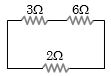
- B
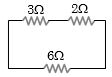
- C
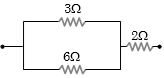
- DNone of these
Explore More
Similar Questions
Explain the series connection of resistors. Derive the equation for the equivalent resistance $(R_S)$.
Medium
View Solution$A$ wire of resistance $100 \Omega$ is stretched so that its length increases by $20 \%$. The stretched wire is then bent in the form of a rectangle whose length and breadth are in the ratio $3: 2$. The effective resistance between the ends of any diagonal of the rectangle is (in $\Omega$)
The equivalent resistance of three unequal resistors connected in parallel is $1 \ \Omega$. If the ratio of two of them is $1:2$ and all resistance values are integers,what is the value of the largest resistor in ohms?
Difficult
View SolutionWhat equal length of an iron wire and a copper-nickel alloy wire, each of $2 \; mm$ diameter, connected in parallel, gives an equivalent resistance of $3 \; \Omega$? (Given: resistivities of iron and copper-nickel alloy wire are $12 \; \mu\Omega \cdot cm$ and $51 \; \mu\Omega \cdot cm$ respectively) (in $m$)
DifficultJEE MAIN 2021
View SolutionObtain the expression for the equivalent resistance for $3$ resistors connected in parallel and also write the expression of equivalent resistance for connection of $n$ resistors.
Medium
View SolutionVedclass Products
For Students
Vedclass Test Series
Mock tests in real JEE/NEET style with performance analysis. 5-day free trial.
Start Free TrialFor Teachers
Exam Paper Generator
Generate Set A/B/C/D exam papers from 7.5L+ questions in 2 minutes. 3 chapters free.
Try FreeFor Institutes
Online Exam Module
Live online exams with unlimited students, 360° analytics & white-label branding.
See Demo