
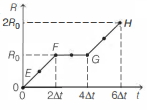
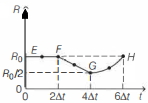
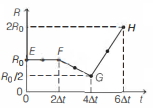
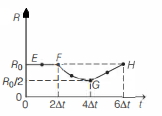
In the circuit shown below,the resistance and the emf source are both variable. The graph of seven readings of the voltmeter and the ammeter ($V$ and $I$,respectively) for different settings of resistance and the emf,taken at equal intervals of time $\Delta t$,are shown below by the dots connected by the curve $EFGH$. Consider the internal resistance of the battery to be negligible and the voltmeter and ammeter to be ideal devices. (Take $R_0 = \frac{V_0}{I_0}$). Then,the plot of the resistance as a function of time corresponding to the curve $EFGH$ is given by:
- A
- B
- C
- D
Explore More
Similar Questions
Answer the following questions:
$(a)$ $A$ steady current flows in a metallic conductor of non-uniform cross-section. Which of these quantities is constant along the conductor: current, current density, electric field, drift speed?
$(b)$ Is Ohm's law universally applicable for all conducting elements? If not, give examples of elements which do not obey Ohm's law.
$(c)$ $A$ low voltage supply from which one needs high currents must have very low internal resistance. Why?
$(d)$ $A$ high tension $(HT)$ supply of, say, $6 \ kV$ must have a very large internal resistance. Why?
$(a)$ $A$ steady current flows in a metallic conductor of non-uniform cross-section. Which of these quantities is constant along the conductor: current, current density, electric field, drift speed?
$(b)$ Is Ohm's law universally applicable for all conducting elements? If not, give examples of elements which do not obey Ohm's law.
$(c)$ $A$ low voltage supply from which one needs high currents must have very low internal resistance. Why?
$(d)$ $A$ high tension $(HT)$ supply of, say, $6 \ kV$ must have a very large internal resistance. Why?
Medium
View SolutionSuppose the drift velocity $v_d$ in a material varies with the applied electric field $E$ as $v_d \propto \sqrt{E}$. Then the $V-I$ graph for a wire made of such a material is best given by:
DifficultJEE MAIN 2015
View SolutionThe heater of an electric kettle is made of a wire of length $L$ and diameter $d$. It takes $4$ minutes to raise the temperature of $0.5 \ kg$ of water by $40 \ K$. This heater is replaced by a new heater having two wires of the same material,each of length $L$ and diameter $2d$. The way these wires are connected is given in the options. How much time in minutes will it take to raise the temperature of the same amount of water by $40 \ K$?
$(A)$ $4$ if wires are in parallel
$(B)$ $2$ if wires are in series
$(C)$ $1$ if wires are in series
$(D)$ $0.5$ if wires are in parallel
$(A)$ $4$ if wires are in parallel
$(B)$ $2$ if wires are in series
$(C)$ $1$ if wires are in series
$(D)$ $0.5$ if wires are in parallel
$A$ cell of emf $E$ is connected to a resistance $R_{1}$ for time $t$ and the amount of heat generated in it is $H$. If the resistance $R_{1}$ is replaced by another resistance $R_{2}$ and is connected to the cell for the same time $t$, the amount of heat generated in $R_{2}$ is $4H$. Then the internal resistance $r$ of the cell is:
DifficultWBJEE 2013
View SolutionIdentify the correctness of the following statements:
$(1)$ The product of a volt and a coulomb is a joule.
$(2)$ The product of a volt and an ampere is a joule/second.
$(3)$ The product of a volt and a watt is a horsepower.
$(4)$ $A$ watt-hour can be measured in terms of an electron volt.
$(1)$ The product of a volt and a coulomb is a joule.
$(2)$ The product of a volt and an ampere is a joule/second.
$(3)$ The product of a volt and a watt is a horsepower.
$(4)$ $A$ watt-hour can be measured in terms of an electron volt.
Easy
View SolutionVedclass Products
For Students
Vedclass Test Series
Mock tests in real JEE/NEET style with performance analysis. 5-day free trial.
Start Free TrialFor Teachers
Exam Paper Generator
Generate Set A/B/C/D exam papers from 7.5L+ questions in 2 minutes. 3 chapters free.
Try FreeFor Institutes
Online Exam Module
Live online exams with unlimited students, 360° analytics & white-label branding.
See Demo