
The principal organic product of the reaction will be:
- A
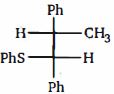
- B

- C
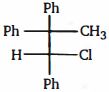
- D
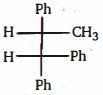
Explore More
Similar Questions
What is the major product formed when $2$-bromopentane reacts with alcoholic $KOH$?
$ \xrightarrow[Acetone]{NaI} \underset{(Major)}{X} $ $ \xrightarrow[{S_N2}]{aq. KOH} \underset{(Major)}{Y} $
$X$ and $Y$ should be
$X$ and $Y$ should be
Match the $CH_{3}X$ compounds in Column-$(I)$ with their $C-X$ bond length in Column-$(II)$ and dipole moment in Column-$(III)$.
$(I)$ Compound $(II)$ $C-X$ Bond Length $(pm)$ $(III)$ Dipole Moment $(D)$ $(A)$ $H_3C-F$ $(i)$ $214$ $(1)$ $1.636$ $(B)$ $H_3C-Cl$ $(ii)$ $193$ $(2)$ $1.830$ $(C)$ $H_3C-Br$ $(iii)$ $178$ $(3)$ $1.847$ $(D)$ $H_3C-I$ $(iv)$ $139$ $(4)$ $1.860$
| $(I)$ Compound | $(II)$ $C-X$ Bond Length $(pm)$ | $(III)$ Dipole Moment $(D)$ |
| $(A)$ $H_3C-F$ | $(i)$ $214$ | $(1)$ $1.636$ |
| $(B)$ $H_3C-Cl$ | $(ii)$ $193$ | $(2)$ $1.830$ |
| $(C)$ $H_3C-Br$ | $(iii)$ $178$ | $(3)$ $1.847$ |
| $(D)$ $H_3C-I$ | $(iv)$ $139$ | $(4)$ $1.860$ |
Difficult
View SolutionExplain elimination reactions of alkyl halides.
or
Explain dehydrohalogenation ($\beta$-elimination) of alkyl halides.
or
Explain dehydrohalogenation ($\beta$-elimination) of alkyl halides.
Medium
View SolutionWhich of the following haloalkanes reacts with aqueous $KOH$ most easily? Explain giving reason.
$(i)$ $1$-Bromobutane
$(ii)$ $2$-Bromobutane
$(iii)$ $2$-Bromo-$2$-methylpropane
$(iv)$ $2$-Chlorobutane
$(i)$ $1$-Bromobutane
$(ii)$ $2$-Bromobutane
$(iii)$ $2$-Bromo-$2$-methylpropane
$(iv)$ $2$-Chlorobutane
Medium
View SolutionVedclass Products
For Students
Vedclass Test Series
Mock tests in real JEE/NEET style with performance analysis. 5-day free trial.
Start Free TrialFor Teachers
Exam Paper Generator
Generate Set A/B/C/D exam papers from 7.5L+ questions in 2 minutes. 3 chapters free.
Try FreeFor Institutes
Online Exam Module
Live online exams with unlimited students, 360° analytics & white-label branding.
See Demo