
Difficult
Reactant $A$ converts to product $D$ through the given mechanism (with the net evolution of heat) :
$A \rightarrow B$ $slow ; \Delta H=+ve$ $B \rightarrow C$ $fast ; \Delta H=-ve$ $C \rightarrow D$ $fast ; \Delta H=-ve$
Which of the following represents the above reaction mechanism ?
| $A \rightarrow B$ | $slow ; \Delta H=+ve$ |
| $B \rightarrow C$ | $fast ; \Delta H=-ve$ |
| $C \rightarrow D$ | $fast ; \Delta H=-ve$ |
Which of the following represents the above reaction mechanism ?
- A
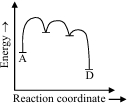
- B
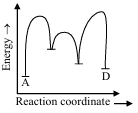
- C
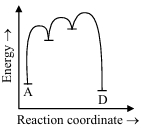
- D
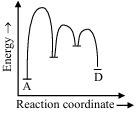
Explore More
Similar Questions
$A$ mixture of $H_2$ and $O_2$ is very stable at room temperature. However,it explodes immediately upon sparking. This is because .........
Medium
View SolutionChoose the incorrect statement -
Medium
View SolutionFor the reaction,following data is given,
$A \rightarrow B$; $K_1 = 10^{15} \exp \left( \frac{-2000}{T} \right)$
$C \rightarrow D$; $K_2 = 10^{14} \exp \left( \frac{-1000}{T} \right)$
The temperature at which $K_1 = K_2$ is ........... $K$ $(exp. = e)$
$A \rightarrow B$; $K_1 = 10^{15} \exp \left( \frac{-2000}{T} \right)$
$C \rightarrow D$; $K_2 = 10^{14} \exp \left( \frac{-1000}{T} \right)$
The temperature at which $K_1 = K_2$ is ........... $K$ $(exp. = e)$
Medium
View SolutionThe activation energy of a first-order reaction at $25\,^{\circ}C$ is $30\,kJ/mol$. In the presence of a catalyst,the activation energy of the same reaction at $25\,^{\circ}C$ becomes $24\,kJ/mol$. The rate of the reaction in the presence of the catalyst will be how many times the original rate?
Difficult
View SolutionThe rate constant of a reaction is $2 \times 10^{-3} \ min^{-1}$ at $300 \ K$. When the temperature is increased by $20 \ K$,the rate constant becomes three times its initial value. Calculate the activation energy $(E_a)$ of the reaction. Also,determine the rate constant at $310 \ K$.
Difficult
View SolutionVedclass Products
For Students
Vedclass Test Series
Mock tests in real JEE/NEET style with performance analysis. 5-day free trial.
Start Free TrialFor Teachers
Exam Paper Generator
Generate Set A/B/C/D exam papers from 7.5L+ questions in 2 minutes. 3 chapters free.
Try FreeFor Institutes
Online Exam Module
Live online exams with unlimited students, 360° analytics & white-label branding.
See Demo