
Starting from the centre of the earth having radius $R$,the variation of $g$ (acceleration due to gravity) is shown by:
- A
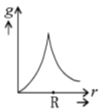
- B
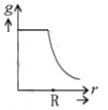
- C
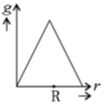
- D
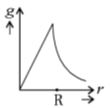
Explore More
Similar Questions
The difference in the acceleration due to gravity at the pole and equator is ( $g=$ acceleration due to gravity,$R=$ radius of earth,$\theta=$ latitude,$\omega=$ angular velocity,$\cos 0^{\circ}=1, \cos 90^{\circ}=0$ ).
The percentage decrease in the weight of a body when taken to a height of $48 \text{ km}$ above the surface of the earth is (Radius of the earth is $6400 \text{ km}$) (in $\%$)
DifficultMHT CET 2026
View SolutionTwo planets of radii in the ratio $2 : 3$ are made from the material of density in the ratio $3 : 2$. Then the ratio of acceleration due to gravity $g_1/g_2$ at the surface of the two planets will be
Difficult
View SolutionIf $R_{E}$ is the radius of the Earth,then the ratio between the acceleration due to gravity at a depth $r$ below and a height $r$ above the Earth's surface is: (Given: $r < R_{E}$)
DifficultJEE MAIN 2021
View SolutionThe gravitational force of the Earth on a rocket at a height $h$ from the surface of the Earth is $\frac{1}{3}$ of the gravitational force on the surface of the Earth. Find the relationship between $h$ and $R_e$ (the radius of the Earth).
Medium
View SolutionVedclass Products
For Students
Vedclass Test Series
Mock tests in real JEE/NEET style with performance analysis. 5-day free trial.
Start Free TrialFor Teachers
Exam Paper Generator
Generate Set A/B/C/D exam papers from 7.5L+ questions in 2 minutes. 3 chapters free.
Try FreeFor Institutes
Online Exam Module
Live online exams with unlimited students, 360° analytics & white-label branding.
See Demo