
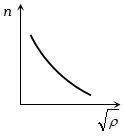
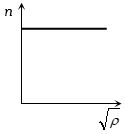
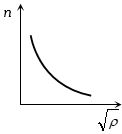
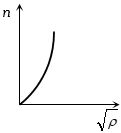
The correct graph between the frequency $n$ and the square root of density $(\rho)$ of a wire,keeping its length,radius,and tension constant,is:
- A
- B
- C
- D
Explore More
Similar Questions
Two identical strings of length $\ell$ and $2\ell$ vibrate with fundamental frequencies $N$ Hz and $1.5N$ Hz,respectively. The ratio of tensions for the smaller length to the larger length is
At poles,a stretched wire of a given length vibrates in unison with a tuning fork. At the equator,for the same setting,to produce resonance with the same fork,the vibrating length of the wire
The length of a sonometer wire tuned to a frequency of $250 \ Hz$ is $0.60 \ m$. The frequency of the tuning fork with which the vibrating wire will be in tune when the length is made $0.40 \ m$ is .... $Hz$.
Easy
View SolutionThe fundamental frequency of a sonometer wire is $n$. If the length,tension,and diameter of the wire are all tripled,what is the new fundamental frequency?
Difficult
View SolutionUnlike a laboratory sonometer,a stringed instrument is seldom plucked in the middle. Supposing a sitar string is plucked at about $\frac{1}{4}$th of its length from the end. The most prominent harmonic would be
Easy
View SolutionVedclass Products
For Students
Vedclass Test Series
Mock tests in real JEE/NEET style with performance analysis. 5-day free trial.
Start Free TrialFor Teachers
Exam Paper Generator
Generate Set A/B/C/D exam papers from 7.5L+ questions in 2 minutes. 3 chapters free.
Try FreeFor Institutes
Online Exam Module
Live online exams with unlimited students, 360° analytics & white-label branding.
See Demo