
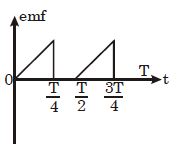
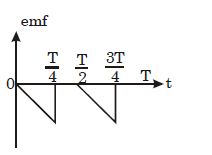
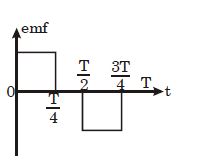
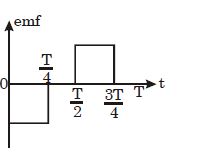
The current $i$ in a coil varies with time as shown in the figure. The variation of induced $emf$ with time would be:
- A
- B
- C
- D
Explore More
Similar Questions
$A$ very long solenoid of radius $R$ is carrying current $I(t) = kt e^{-\alpha t}$ $(k > 0)$,as a function of time $(t \geq 0)$. Counter-clockwise current is taken to be positive. $A$ circular conducting coil of radius $2R$ is placed in the equatorial plane of the solenoid and is concentric with the solenoid. The induced current in the outer coil as a function of time is correctly depicted by:
DifficultJEE MAIN 2019
View Solution$A$ thin conducting rod $MN$ of mass $20 \text{ g}$,length $25 \text{ cm}$ and resistance $10 \text{ }\Omega$ is held on frictionless,long,perfectly conducting vertical rails as shown in the figure. There is a uniform magnetic field $B_0 = 4 \text{ T}$ directed perpendicular to the plane of the rod-rail arrangement. The rod is released from rest at time $t = 0$ and it moves down along the rails. Assume air drag is negligible. Match each quantity in List-$I$ with an appropriate value from List-$II$,and choose the correct option. [Given: The acceleration due to gravity $g = 10 \text{ m s}^{-2}$ and $e^{-1} = 0.4$]
List-$I$ List-$II$ $(P)$ At $t = 0.2 \text{ s}$,the magnitude of the induced emf in Volt $(1)$ $0.07$ $(Q)$ At $t = 0.2 \text{ s}$,the magnitude of the magnetic force in Newton $(2)$ $0.144$ $(R)$ At $t = 0.2 \text{ s}$,the power dissipated as heat in Watt $(3)$ $1.20$ $(S)$ The magnitude of terminal velocity of the rod in $\text{m s}^{-1}$ $(4)$ $0.12$ $(5)$ $2.00$
| List-$I$ | List-$II$ |
| $(P)$ At $t = 0.2 \text{ s}$,the magnitude of the induced emf in Volt | $(1)$ $0.07$ |
| $(Q)$ At $t = 0.2 \text{ s}$,the magnitude of the magnetic force in Newton | $(2)$ $0.144$ |
| $(R)$ At $t = 0.2 \text{ s}$,the power dissipated as heat in Watt | $(3)$ $1.20$ |
| $(S)$ The magnitude of terminal velocity of the rod in $\text{m s}^{-1}$ | $(4)$ $0.12$ |
| $(5)$ $2.00$ |
DifficultIIT 2023
View SolutionNear a circular loop of conducting wire as shown in the figure,an electron moves along a straight line. The direction of the induced current,if any,in the loop is
MediumKCET 2009
View SolutionWhen a coil is placed in a time-dependent magnetic field, the power dissipated in it is $P$. The number of turns, area of the coil, and radius of the coil wire are $N, A$, and $r$ respectively. For a second coil, the number of turns, area, and radius are $2N, 2A$, and $3r$ respectively. When the first coil is replaced with the second coil, the power dissipated in it is $\alpha P$. The value of $\alpha$ is . . . . . . .
DifficultJEE MAIN 2026
View Solution$A$ current $I = 10 \ A$ is passed through the part of a circuit shown in the figure. What will be the potential difference between $A$ and $B$ when $I$ is decreased at a constant rate of $10^2 \ A \ s^{-1}$ (in $V$)?
DifficultAP EAMCET 2020
View SolutionVedclass Products
For Students
Vedclass Test Series
Mock tests in real JEE/NEET style with performance analysis. 5-day free trial.
Start Free TrialFor Teachers
Exam Paper Generator
Generate Set A/B/C/D exam papers from 7.5L+ questions in 2 minutes. 3 chapters free.
Try FreeFor Institutes
Online Exam Module
Live online exams with unlimited students, 360° analytics & white-label branding.
See Demo