
The current flowing through an inductor of self-inductance $L$ is continuously increasing at a constant rate. The variation of induced e.m.f. $(e)$ versus $dI/dt$ is shown graphically by which figure?
- A
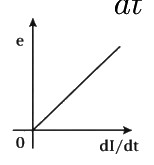
- B
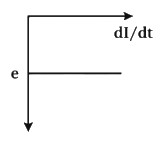
- C
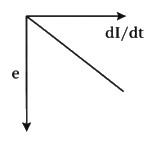
- D
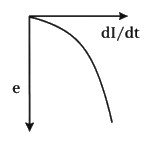
Explore More
Similar Questions
The length of a wire required to make a solenoid of length $l$ and self-induction $L$ is
$A$ hollow cylinder has length $l$,radius $r$,and thickness $d$,where $l >> r >> d$,and is made of a material with resistivity $\rho$. $A$ time-varying current $I$ flows through the cylinder in the tangential direction. Assume the current is always uniformly distributed along the length of the cylinder. The cylinder is fixed so that it cannot move; assume that there are no externally generated magnetic fields during the time considered for the problems below. Assume current at $t = 0$ to be $I_0$. What is the current $I(t)$ for $t > 0$?
Difficult
View Solution$A$ branch of a circuit is shown in the figure. If the current is decreasing at the rate of $10^3 \ A \ s^{-1}$, then the potential difference between $A$ and $B$ is (in $V$)
When a current of $1 \,A$ is passed through a coil of $100$ turns, the flux associated with it is $2.5 \times 10^{-5} \,Wb/\text{turn}$. The self-inductance of the coil in millihenry is:
The coefficient of self-inductance of a solenoid is $0.18\, mH$. If a core of soft iron of relative permeability $900$ is inserted,then the coefficient of self-inductance will become nearly.....$mH$.
Easy
View SolutionVedclass Products
For Students
Vedclass Test Series
Mock tests in real JEE/NEET style with performance analysis. 5-day free trial.
Start Free TrialFor Teachers
Exam Paper Generator
Generate Set A/B/C/D exam papers from 7.5L+ questions in 2 minutes. 3 chapters free.
Try FreeFor Institutes
Online Exam Module
Live online exams with unlimited students, 360° analytics & white-label branding.
See Demo