
The graph which depicts the results of the Rutherford gold foil experiment with $\alpha$-particles is:
$\theta$: Scattering angle
$Y$: Number of scattered $\alpha$-particles detected
(Plots are schematic and not to scale)
$\theta$: Scattering angle
$Y$: Number of scattered $\alpha$-particles detected
(Plots are schematic and not to scale)
- A
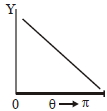
- B
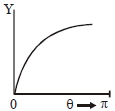
- C
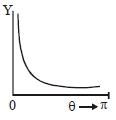
- D
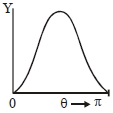
Explore More
Similar Questions
Discuss the experimental results of Geiger-Marsden's $\alpha$-particle scattering.
Difficult
View SolutionIn a Rutherford scattering experiment,when a projectile of charge $Z_1$ and mass $M_1$ approaches a target nucleus of charge $Z_2$ and mass $M_2$,the distance of closest approach is $r_0$. The energy of the projectile is:
MediumAIPMT 2009
View Solution$A$ neutron collides head-on with a stationary hydrogen atom in its ground state. Which of the following statements are correct? (Assume that the hydrogen atom and neutron have the same mass):
Difficult
View SolutionThe Rutherford $\alpha$-particle experiment shows that most of the $\alpha$-particles pass through almost unscattered while some are scattered through large angles. What information does it give about the structure of the atom?
Medium
View SolutionIn a Geiger-Marsden experiment,what is the distance of closest approach to the nucleus of a $7.7 \;MeV$ $\alpha$-particle before it comes momentarily to rest and reverses its direction?
Medium
View SolutionVedclass Products
For Students
Vedclass Test Series
Mock tests in real JEE/NEET style with performance analysis. 5-day free trial.
Start Free TrialFor Teachers
Exam Paper Generator
Generate Set A/B/C/D exam papers from 7.5L+ questions in 2 minutes. 3 chapters free.
Try FreeFor Institutes
Online Exam Module
Live online exams with unlimited students, 360° analytics & white-label branding.
See Demo