
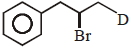
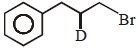
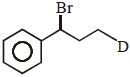
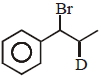
Explore More
Similar Questions
When a hydrocarbon $A$ undergoes complete combustion,it requires $11$ equivalents of oxygen and produces $4$ equivalents of water. What is the molecular formula of $A$?
DifficultJEE MAIN 2023
View Solution$CH_2(COOH)_2 \xrightarrow{P_4O_{10}, \, 150^\circ C} X$
Compound $(X)$ is
Compound $(X)$ is
Medium
View SolutionWhat is the product of $1, 4$-addition in the reaction shown below?
Medium
View SolutionAnswer the following questions:
$(i)$ What is the bond length of $C-C$,$C=C$,and $C\equiv C$?
$(ii)$ What will be the effect on bond length as bond multiplicity increases?
$(iii)$ What is the relation between reactivity of compound,bond strength and bond order between two carbon atoms?
$(iv)$ What is the rate of reaction of $Cl_2, Br_2,$ and $I_2$ with $CH_2=CH_2$?
$(v)$ What is the difference between $2-$butyne and $1-$butyne? By which test can we distinguish between these two?
$(vi)$ Which real product is obtained on hydrolysis of alkyne? Why?
$(vii)$ Give the structure and $IUPAC$ name:
$(a)$ Vinyl chloride
$(b)$ Vinyl cyanide
$(c)$ Glyoxal
$(d)$ Silver acetylide
$(e)$ Diacetyl
$(f)$ Glycol
$(i)$ What is the bond length of $C-C$,$C=C$,and $C\equiv C$?
$(ii)$ What will be the effect on bond length as bond multiplicity increases?
$(iii)$ What is the relation between reactivity of compound,bond strength and bond order between two carbon atoms?
$(iv)$ What is the rate of reaction of $Cl_2, Br_2,$ and $I_2$ with $CH_2=CH_2$?
$(v)$ What is the difference between $2-$butyne and $1-$butyne? By which test can we distinguish between these two?
$(vi)$ Which real product is obtained on hydrolysis of alkyne? Why?
$(vii)$ Give the structure and $IUPAC$ name:
$(a)$ Vinyl chloride
$(b)$ Vinyl cyanide
$(c)$ Glyoxal
$(d)$ Silver acetylide
$(e)$ Diacetyl
$(f)$ Glycol
Medium
View SolutionThe reagents $A$ and $B$ in the above reaction are:
Medium
View SolutionVedclass Products
For Students
Vedclass Test Series
Mock tests in real JEE/NEET style with performance analysis. 5-day free trial.
Start Free TrialFor Teachers
Exam Paper Generator
Generate Set A/B/C/D exam papers from 7.5L+ questions in 2 minutes. 3 chapters free.
Try FreeFor Institutes
Online Exam Module
Live online exams with unlimited students, 360° analytics & white-label branding.
See Demo