
The potential in an electric field varies as $V = (x^2 - y^2)$. The electric lines of force in the $X-Y$ plane are
- A
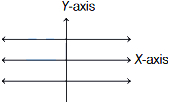
- B
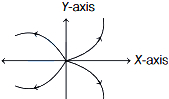
- C
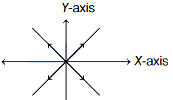
- D
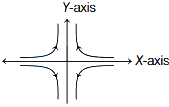
Explore More
Similar Questions
Electric lines of force about a negative point charge are:
Easy
View SolutionSix point charges are placed at the vertices of a regular hexagon of side $a$ as shown in the figure. Three charges are $+Q$ and three are $-Q$ arranged alternately. The electric field intensity at a point on the line passing through the centre $O$ and perpendicular to the plane of the figure at a large distance $x (x \gg a)$ from $O$ is (Let $\frac{1}{4 \pi \epsilon_0} = k$):
DifficultAP EAMCET 2019
View SolutionThe insulation property of air breaks down at $E = 3 \times 10^6 \ V/m$. The maximum charge that can be given to a sphere of diameter $5 \ m$ is approximately (in coulombs):
Easy
View SolutionThe distance between two charges $25\,\mu C$ and $36\,\mu C$ is $11\,cm$. At what point on the line joining the two charges will the electric field intensity be zero?
Medium
View Solution$A$ point charge of $50 \mu C$ is placed in the $XY$ plane at a location with radius vector $\vec{r}_0 = 2 \hat{i} + 3 \hat{j} \ m$. The electric field strength magnitude at a point with radius vector $\vec{r} = 8 \hat{i} - 5 \hat{j} \ m$ is (Given: $\frac{1}{4 \pi \varepsilon_0} = 9 \times 10^9 \ N \ m^2 \ C^{-2}$). (in $kV \ m^{-1}$)
Vedclass Products
For Students
Vedclass Test Series
Mock tests in real JEE/NEET style with performance analysis. 5-day free trial.
Start Free TrialFor Teachers
Exam Paper Generator
Generate Set A/B/C/D exam papers from 7.5L+ questions in 2 minutes. 3 chapters free.
Try FreeFor Institutes
Online Exam Module
Live online exams with unlimited students, 360° analytics & white-label branding.
See Demo