
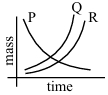
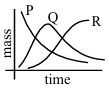
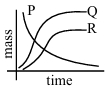
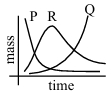
$A$ radioactive material $P$ first decays into $Q$ and then $Q$ decays to non-radioactive material $R$. Which of the following figures represents the time-dependent mass of $P$,$Q$,and $R$?
- A
- B
- C
- D
Explore More
Similar Questions
In the given nuclear reaction,$A, B, C, D, E$ represent:
$_{92}U^{238} \xrightarrow{\alpha} _{B}Th^{A} \xrightarrow{\beta} _{D}Pa^{C} \xrightarrow{E} _{92}U^{234}$
$_{92}U^{238} \xrightarrow{\alpha} _{B}Th^{A} \xrightarrow{\beta} _{D}Pa^{C} \xrightarrow{E} _{92}U^{234}$
Medium
View Solution$A$ free neutron decays spontaneously into :
In the given reaction sequence ${ }_z X^A \rightarrow{ }_{z+1} Y^A \rightarrow{ }_{z-1} K^{A-4} \rightarrow{ }_{z-1} K^{A-4}$,identify the radioactive radiations emitted in order.
$A$ radioactive nucleus with $Z$ protons and $N$ neutrons emits an $\alpha$-particle,$2\beta^-$-particles,and $2$ gamma rays. The number of protons and neutrons in the nucleus left after the decay,respectively,are:
Medium
View Solution$A$ radioactive nucleus undergoes a series of decays according to the scheme
$A \xrightarrow{\alpha} A_1 \xrightarrow{\beta} A_2 \xrightarrow{\alpha} A_3 \xrightarrow{\gamma} A_4$
If the mass number and atomic number of $A$ are $180$ and $72$,respectively,then what are these numbers for $A_4$?
$A \xrightarrow{\alpha} A_1 \xrightarrow{\beta} A_2 \xrightarrow{\alpha} A_3 \xrightarrow{\gamma} A_4$
If the mass number and atomic number of $A$ are $180$ and $72$,respectively,then what are these numbers for $A_4$?
Difficult
View SolutionVedclass Products
For Students
Vedclass Test Series
Mock tests in real JEE/NEET style with performance analysis. 5-day free trial.
Start Free TrialFor Teachers
Exam Paper Generator
Generate Set A/B/C/D exam papers from 7.5L+ questions in 2 minutes. 3 chapters free.
Try FreeFor Institutes
Online Exam Module
Live online exams with unlimited students, 360° analytics & white-label branding.
See Demo