
$A$ particle moves under the influence of a force $F = -2x$ in one dimension (where $x$ is the distance of the particle from the origin). Assume that the potential energy of the particle at the origin is zero. The schematic diagram of the potential energy $U$ as a function of $x$ is given by:
- A
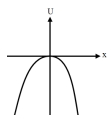
- B
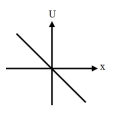
- C
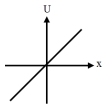
- D
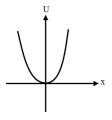
Explore More
Similar Questions
$A$ chain of mass $m$ and length $l$ is hanging freely from edge $A$ (as shown in diagram $I$). Calculate the work done to fold it as shown in diagram $(II)$.
Medium
View SolutionThe diagrams represent the potential energy $U$ as a function of the inter-atomic distance $r$. Which diagram corresponds to stable molecules found in nature?
Difficult
View SolutionIf the potential energy of a particle of mass $0.1 \ kg$ moving along $x$-axis is $U(x) = 5x(x-4) \ J$,then the speed of the particle is maximum at a position of
$A$ uniform chain of length $L$ and mass $M$ is lying on a smooth table and one-third of its length is hanging vertically down over the edge of the table. If $g$ is the acceleration due to gravity, the work required to pull the hanging part onto the table is
DifficultIIT 1985
View Solution$A$ uniform chain of length $l$ and mass $m$ lies on the surface of a smooth hemisphere of radius $R$ $(R > l)$ with one end tied to the top of the hemisphere as shown in the figure. Gravitational potential energy of the chain with respect to the base of the hemisphere is
DifficultAP EAMCET 2018
View SolutionVedclass Products
For Students
Vedclass Test Series
Mock tests in real JEE/NEET style with performance analysis. 5-day free trial.
Start Free TrialFor Teachers
Exam Paper Generator
Generate Set A/B/C/D exam papers from 7.5L+ questions in 2 minutes. 3 chapters free.
Try FreeFor Institutes
Online Exam Module
Live online exams with unlimited students, 360° analytics & white-label branding.
See Demo