
Which of the following graphs between the rate constant $(k)$ and temperature $(T)$ represents the Arrhenius equation?
- A

- B
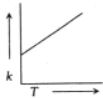
- C

- D

Explore More
Similar Questions
Collision theory is used to explain how chemical species undergo a reaction. Using this theory and the kinetic molecular model,which of the following does $NOT$ influence the rate of a chemical reaction?
MediumAIIMS 2016
View SolutionThe half-life periods of a first order reaction at $300 \ K$ and $400 \ K$ are $50 \ s$ and $10 \ s$ respectively. The activation energy of the reaction in $kJ \ mol^{-1}$ is $(\log 5 = 0.70)$
For a first-order reaction at $300 \, ^\circ C$,the activation energy is $35 \, kcal \, mol^{-1}$ and the frequency factor is $1.45 \times 10^{11} \, s^{-1}$. Calculate the rate constant.
Medium
View SolutionFor a first-order reaction $A \to P$,the rate constant equation is given by $\log K = -2000 \, (1/T) + 6.0$. The pre-exponential factor $A$ and the activation energy $E_a$ are,respectively:
Medium
View SolutionAccording to the Arrhenius equation,which of the following statements are correct?
$(A)$ $A$ high activation energy usually implies a fast reaction.
$(B)$ Rate constant increases with increase in temperature. This is due to a greater number of collisions whose energy exceeds the activation energy.
$(C)$ Higher the magnitude of activation energy,stronger is the temperature dependence of the rate constant.
$(D)$ The pre-exponential factor is a measure of the rate at which collisions occur,irrespective of their energy.
$(A)$ $A$ high activation energy usually implies a fast reaction.
$(B)$ Rate constant increases with increase in temperature. This is due to a greater number of collisions whose energy exceeds the activation energy.
$(C)$ Higher the magnitude of activation energy,stronger is the temperature dependence of the rate constant.
$(D)$ The pre-exponential factor is a measure of the rate at which collisions occur,irrespective of their energy.
Vedclass Products
For Students
Vedclass Test Series
Mock tests in real JEE/NEET style with performance analysis. 5-day free trial.
Start Free TrialFor Teachers
Exam Paper Generator
Generate Set A/B/C/D exam papers from 7.5L+ questions in 2 minutes. 3 chapters free.
Try FreeFor Institutes
Online Exam Module
Live online exams with unlimited students, 360° analytics & white-label branding.
See Demo