
Medium
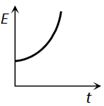
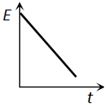
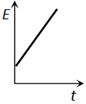
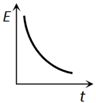
$A$ particle is released from a height $h$. The particle is given a constant horizontal velocity. Assuming $g$ remains constant everywhere, which graph correctly represents the kinetic energy $E$ of the particle with respect to time $t$?
- A
- B
- C
- D
Explore More
Similar Questions
$A$ wooden block of mass $M$ rests on a horizontal surface. $A$ bullet of mass $m$ moving in the horizontal direction strikes and gets embedded in it. The combined system covers a distance $x$ on the surface. If the coefficient of friction between the wood and the surface is $\mu$,the speed of the bullet at the time of striking the block is:
Difficult
View SolutionTwo bodies of masses $m_{1}$ and $m_{2}$ are acted upon by a constant force $F$ for a time $t$. They start from rest and acquire kinetic energies,$E_{1}$ and $E_{2}$ respectively. Then $\frac{E_{1}}{E_{2}}$ is
MediumKCET 2012
View Solution$A$ $1.0\, kg$ block collides with a horizontal weightless spring of force constant $2.75\, N/m$ as shown in the figure. The block compresses the spring $4.0\, m$ from the rest position. If the coefficient of kinetic friction between the block and the horizontal surface is $0.25$,the speed of the block at the instant of collision is ................. $m/s$.
Medium
View Solution$A$ block of mass $m(=0.1 \ kg)$ is hanging over a frictionless light fixed pulley by an inextensible string of negligible mass. The other end of the string is pulled by a constant force $F$ in the vertically downward direction. The linear momentum of the block increases by $2 \ kg \ m/s$ in $1 \ s$ after the block starts from rest. Then, (given $g=10 \ m/s^2$):
MediumWBJEE 2013
View Solution$A$ machine which is $75\%$ efficient, uses $12 \, J$ of energy in lifting up a $1 \, kg$ mass through a certain distance. The mass is then allowed to fall through that distance. The velocity at the end of its fall is (in $m \, s^{-1}$):
Medium
View SolutionVedclass Products
For Students
Vedclass Test Series
Mock tests in real JEE/NEET style with performance analysis. 5-day free trial.
Start Free TrialFor Teachers
Exam Paper Generator
Generate Set A/B/C/D exam papers from 7.5L+ questions in 2 minutes. 3 chapters free.
Try FreeFor Institutes
Online Exam Module
Live online exams with unlimited students, 360° analytics & white-label branding.
See Demo