
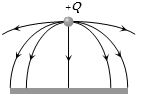
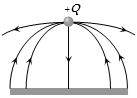
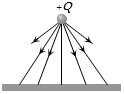
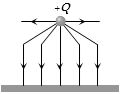
$A$ charge $Q$ is fixed at a distance $d$ in front of an infinite metal plate. The lines of force are represented by
- A
- B
- C
- D
Explore More
Similar Questions
Two identical charged spheres suspended from a common point by two massless strings of length $l$ are initially a distance $d$ $(d \ll l)$ apart because of their mutual repulsion. The charge begins to leak from both the spheres at a constant rate. As a result,the spheres approach each other with a velocity $v$. Then,as a function of distance $x$ between them,
Difficult
View SolutionFour charges are arranged at the corners of a square $ABCD$,as shown. The force on a $+ve$ charge kept at the centre of the square is
Easy
View SolutionSuppose the charge of a proton and an electron differ slightly. One of them is $-e,$ the other is $(e + \Delta e).$ If the net electrostatic force and gravitational force between two hydrogen atoms placed at a distance $d$ (much greater than atomic size) apart is zero, then $\Delta e$ is of the order of $[$ Given: mass of hydrogen $m_h = 1.67 \times 10^{-27} \, kg]$
DifficultNEET 2017
View SolutionIn the given square $ABCD$,charges $q$,$2q$,$3q$,and $4q$ are placed at corners $A$,$B$,$C$,and $D$ respectively. What is the direction of the net electric field at the center $O$?
Easy
View SolutionTwo charges each of magnitude $Q$ are fixed at a distance of $2a$ apart. $A$ third charge ($-q$ of mass $m$) is placed at the midpoint of the two charges. If the $-q$ charge is slightly displaced perpendicular to the line joining the charges,find its time period.
Difficult
View SolutionVedclass Products
For Students
Vedclass Test Series
Mock tests in real JEE/NEET style with performance analysis. 5-day free trial.
Start Free TrialFor Teachers
Exam Paper Generator
Generate Set A/B/C/D exam papers from 7.5L+ questions in 2 minutes. 3 chapters free.
Try FreeFor Institutes
Online Exam Module
Live online exams with unlimited students, 360° analytics & white-label branding.
See Demo