
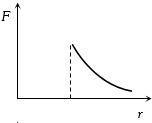
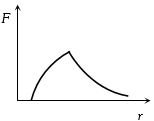
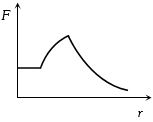
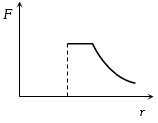
$A$ sphere of mass $M$ and radius $R_2$ has a concentric cavity of radius $R_1$ as shown in the figure. The force $F$ exerted by the sphere on a particle of mass $m$ located at a distance $r$ from the center of the sphere varies as $(0 \le r \le \infty)$. Which of the following graphs correctly represents this variation?
- A
- B
- C
- D
Explore More
Similar Questions
The mass density of a planet of radius $R$ varies with the distance $r$ from its centre as $\rho(r) = \rho_{0} \left(1 - \frac{r^{2}}{R^{2}}\right)$. Then the gravitational field is maximum at:
DifficultJEE MAIN 2020
View SolutionThe mass of the moon is $\frac{M}{81}$,where $M$ is the mass of the earth. The distance between the earth and the moon is $60R$,where $R$ is the radius of the earth. At what distance from the center of the moon will the gravitational intensity be zero (in $R$)?
Difficult
View SolutionWhat is the relationship between gravitational field intensity $(I)$ and gravitational potential $(V)$ at a point?
Medium
View SolutionThe mass density inside a solid sphere of radius $R$ varies as $\rho(r)=\rho_0\left(\frac{r}{R}\right)^\beta$,where $\rho_0$ and $\beta$ are constants and $r$ is the distance from the centre. Let $E_1$ and $E_2$ be gravitational fields due to the sphere at distances $\frac{R}{2}$ and $2R$ from the centre of the sphere,respectively. If $\frac{E_2}{E_1}=4$,the value of $\beta$ is
DifficultTS EAMCET 2018
View SolutionThe gravitational potential versus distance $r$ graph is represented in the figure. The magnitude of the gravitational field intensity is equal to....... $N/kg$.
Medium
View SolutionVedclass Products
For Students
Vedclass Test Series
Mock tests in real JEE/NEET style with performance analysis. 5-day free trial.
Start Free TrialFor Teachers
Exam Paper Generator
Generate Set A/B/C/D exam papers from 7.5L+ questions in 2 minutes. 3 chapters free.
Try FreeFor Institutes
Online Exam Module
Live online exams with unlimited students, 360° analytics & white-label branding.
See Demo