
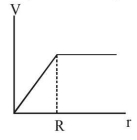
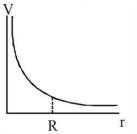
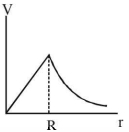
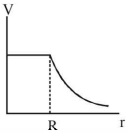
$A$ spherically symmetric gravitational system of particles has a mass density $\rho = \begin{cases} \rho_0 & \text{for } r \leq R \\ 0 & \text{for } r > R \end{cases}$ where $\rho_0$ is a constant. $A$ test mass can undergo circular motion under the influence of the gravitational field of particles. Its speed $V$ as a function of distance $r$ $(0 < r < \infty)$ from the centre of the system is represented by:
- A
- B
- C
- D
Explore More
Similar Questions
If the circle $x^2 + y^2 = a^2$ intersects the hyperbola $xy = c^2$ in four points $P(x_1, y_1), Q(x_2, y_2), R(x_3, y_3), S(x_4, y_4)$,then:
Product $(A)$ is
For $k=1, 2, 3$, the box $B_k$ contains $k$ red balls and $(k+1)$ white balls. Let $P(B_1)=\frac{1}{2}$, $P(B_2)=\frac{1}{3}$, and $P(B_3)=\frac{1}{6}$. $A$ box is selected at random and a ball is drawn from it. If a red ball is drawn, then the probability that it has come from box $B_2$ is:
Molar heat capacity $(C_p)$ of water at constant pressure is $75 \ J \ K^{-1} \ mol^{-1}$. The increase in temperature (in $K$) of $100 \ g$ of water when $1 \ kJ$ of heat is supplied to it is
$A$ rectangular loop of length $l$ and breadth $b$ is placed at a distance of $x$ from an infinitely long wire carrying current $i$ such that the direction of the current is parallel to the breadth. If the loop moves away from the current-carrying wire in a direction perpendicular to it with a velocity $v$,the magnitude of the induced emf in the loop is: ($\mu_0=$ permeability of free space)
Vedclass Products
For Students
Vedclass Test Series
Mock tests in real JEE/NEET style with performance analysis. 5-day free trial.
Start Free TrialFor Teachers
Exam Paper Generator
Generate Set A/B/C/D exam papers from 7.5L+ questions in 2 minutes. 3 chapters free.
Try FreeFor Institutes
Online Exam Module
Live online exams with unlimited students, 360° analytics & white-label branding.
See Demo