
Class 11PhysicsSystem of Particles and Rotational MotionMix Example - System of Particles and Rotational Motion
Medium$A$ thin rod of length '$L$' lies along the $x$-axis with its ends at $x = 0$ and $x = L$. Its linear mass density $\lambda$ varies with $x$ as $\lambda = k{\left( {\frac{x}{L}} \right)^n}$,where $n$ is a non-negative constant. If the position $x_{CM}$ of the center of mass of the rod is plotted against '$n$',which of the following graphs best approximates the dependence of $x_{CM}$ on $n$?
- A
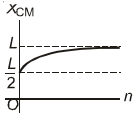
- B
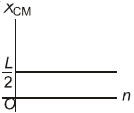
- C
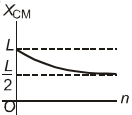
- D
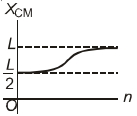
Explore More
Similar Questions
$A$ particle of mass $m$ moving horizontally with velocity $v_0$ strikes a smooth wedge of mass $M$,as shown in the figure. After the collision,the ball starts moving up the inclined face of the wedge and rises to a height $h$. When the particle has risen to a height $h$ on the wedge,choose the correct alternative$(s)$.
Medium
View Solution$A$ block of mass $m$ is attached to a pulley disc of equal mass $m$ and radius $r$ by means of a slack string as shown. The pulley is hinged about its centre on a horizontal table and the block is projected with an initial velocity of $5\, m/s$. Its velocity when the string becomes taut will be
Difficult
View Solution$A$ uniform rod of length $L$ and mass $M$ is placed on a smooth horizontal surface. $A$ particle of mass $m$ moving with velocity $v$ strikes the rod at one end perpendicular to the rod. After the collision,the particle comes to rest. What is the angular velocity of the rod about its centre of mass after the collision?
Difficult
View Solution$A$ wheel of radius $0.5 \ m$ and a moment of inertia of $10 \ kg \cdot m^2$ is rotating freely at an angular speed of $70 \ rev/min$. The wheel can be stopped in $5.0 \ s$ by pressing a wet cloth against the rim and exerting a radially inward force of $88 \ N$. The coefficient of kinetic friction between the wheel and wet cloth is:
DifficultTS EAMCET 2022
View SolutionTwo flywheels are connected by a non-slipping belt as shown in the figure. $I_1 = 4 \ kg \ m^2$,$r_1 = 20 \ cm$,$I_2 = 20 \ kg \ m^2$,and $r_2 = 30 \ cm$. $A$ torque of $10 \ Nm$ is applied on the smaller wheel. Match the entries of column $I$ with appropriate entries of column $II$.
Quantities Their numerical values (in $SI$ units) a. Angular acceleration of smaller wheel $1$. $5/3$ b. Torque on the larger wheel $2$. $100/3$ c. Angular acceleration of larger wheel $3$. $5/2$
| Quantities | Their numerical values (in $SI$ units) |
| a. Angular acceleration of smaller wheel | $1$. $5/3$ |
| b. Torque on the larger wheel | $2$. $100/3$ |
| c. Angular acceleration of larger wheel | $3$. $5/2$ |
MediumKCET 2025
View SolutionVedclass Products
For Students
Vedclass Test Series
Mock tests in real JEE/NEET style with performance analysis. 5-day free trial.
Start Free TrialFor Teachers
Exam Paper Generator
Generate Set A/B/C/D exam papers from 7.5L+ questions in 2 minutes. 3 chapters free.
Try FreeFor Institutes
Online Exam Module
Live online exams with unlimited students, 360° analytics & white-label branding.
See Demo