
$A$ thin spherical shell of radius $R$ has charge $Q$ spread uniformly over its surface. Which of the following graphs most closely represents the electric field $E(r)$ produced by the shell in the range $0 \le r < \infty$,where $r$ is the distance from the centre of the shell?
- A
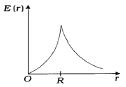
- B
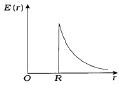
- C
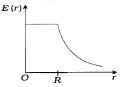
- D
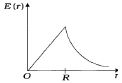
Explore More
Similar Questions
$(a)$ Show that the normal component of the electrostatic field has a discontinuity from one side of a charged surface to another given by $(E_2 - E_1) \cdot \hat{n} = \frac{\sigma}{\varepsilon_0}$, where $\hat{n}$ is a unit vector normal to the surface at a point and $\sigma$ is the surface charge density at that point. (The direction of $\hat{n}$ is from side $1$ to side $2$.) Hence, show that just outside a conductor, the electric field is $\frac{\sigma \hat{n}}{\varepsilon_0}$. $(b)$ Show that the tangential component of the electrostatic field is continuous from one side of a charged surface to another.
Medium
View Solution$A$ uniformly charged thin spherical shell of radius '$R$' has a uniform surface charge density '$\sigma$'. It is made of two identical hemispherical shells held together by pressing them with a force '$F$' as shown. '$F$' is proportional to [$\epsilon_0$ = permittivity of free space].
DifficultMHT CET 2026
View Solution$A$ long, straight wire is surrounded by a hollow, thin, long metal cylinder whose axis coincides with that of the wire. The wire has a charge per unit length of $\lambda$, and the cylinder has a net charge per unit length of $2\lambda$. The radius of the cylinder is $R$. Which of the following statements is correct?
Difficult
View SolutionTwo concentric shells of radii $R$ and $3R$ are placed as shown in the figure. The outer shell carries a charge $Q$. The inner shell is grounded. Find the electric field at point $P$,which is at a distance $2R$ from the center.
Medium
View Solution$A$ large metal plate has a surface charge density of $8.85 \times 10^{-6} \ C \ m^{-2}$. An electron having initial kinetic energy of $8 \times 10^{-17} \ J$ is moving towards the center of the plate. If the electron stops just before reaching the plate,then the initial distance between the electron and the plate is [Take $\epsilon_{0} = 8.85 \times 10^{-12} \ C^{2} \ N^{-1} \ m^{-2}$]
Vedclass Products
For Students
Vedclass Test Series
Mock tests in real JEE/NEET style with performance analysis. 5-day free trial.
Start Free TrialFor Teachers
Exam Paper Generator
Generate Set A/B/C/D exam papers from 7.5L+ questions in 2 minutes. 3 chapters free.
Try FreeFor Institutes
Online Exam Module
Live online exams with unlimited students, 360° analytics & white-label branding.
See Demo