
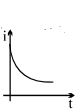
An equilateral triangular loop $ADC$ moves out of a finite magnetic field $B$ as shown in the figure. At time $t = 0$, side $DC$ of the loop is at the edge of the magnetic field. The magnetic field is perpendicular to the paper inwards (or perpendicular to the plane of the coil). The induced current versus time graph will be as:
- A

- B

- C

- D
Explore More
Similar Questions
$A$ conducting loop of radius $R$ is present in a uniform magnetic field $B$ perpendicular to the plane of the ring. If radius $R$ varies as a function of time $t$,as $R = R_0 + t$,the e.m.f. induced in the loop is:
Medium
View Solution$A$ rod closing the circuit shown in the figure moves along a $U$-shaped wire at a constant speed $v$ under the action of a force $F$. The circuit is in a uniform magnetic field perpendicular to the plane. Calculate $F$ if the rate of heat generation in the circuit is $Q$.
Medium
View SolutionDerive the expression for the mechanical power required to move a conducting rod of length $l$ with a constant velocity $v$ in a uniform magnetic field $B$.
Medium
View Solution$A$ constant force $F$ is applied to a conducting rod of length $l$ moving with constant speed $V$ on two parallel conducting rails connected at the ends by a resistance $R$ in a uniform magnetic field $B$,as shown. If the current flowing through the circuit is $I$,then:
Medium
View Solution$A$ rod of length $20 \text{ cm}$ is rotating with an angular speed of $100 \text{ rps}$ in a magnetic field of strength $0.5 \text{ T}$ about one of its ends. What is the potential difference between the two ends of the rod? $(V)$
Medium
View SolutionVedclass Products
For Students
Vedclass Test Series
Mock tests in real JEE/NEET style with performance analysis. 5-day free trial.
Start Free TrialFor Teachers
Exam Paper Generator
Generate Set A/B/C/D exam papers from 7.5L+ questions in 2 minutes. 3 chapters free.
Try FreeFor Institutes
Online Exam Module
Live online exams with unlimited students, 360° analytics & white-label branding.
See Demo