
An observer starts moving with uniform acceleration $a$ toward a stationary sound source emitting a whistle of frequency $n$. As the observer approaches the source,the apparent frequency $n'$ heard by the observer varies with time $t$ as:
- A
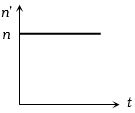
- B
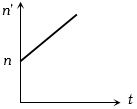
- C
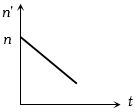
- D
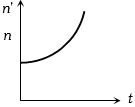
Explore More
Similar Questions
Two cars $A$ and $B$ are moving in the same direction with speeds $36 \, km/hr$ and $54 \, km/hr$ respectively. Car $B$ is ahead of $A$. If $A$ sounds a horn of frequency $1000 \, Hz$ and the speed of sound in air is $340 \, m/s$,the frequency of sound received by the driver of car $B$ is ..... $Hz$.
Difficult
View SolutionWhich pre-assumptions are used for the Doppler effect?
Medium
View SolutionThe apparent frequency of a note,when a listener moves towards a stationary source with a velocity of $40 \ m/s$,is $200 \ Hz$. When the listener moves away from the same source with the same speed,the apparent frequency of the same note is $160 \ Hz$. The velocity of sound in air is (in $m/s$):
Medium
View SolutionIf a source emitting waves of frequency $F$ moves towards an observer with a velocity $V/3$ and the observer moves away from the source with a velocity $V/4$,the apparent frequency as heard by the observer will be ($V=$ velocity of sound).
An obstacle is moving towards the source with velocity $v$. The sound is reflected from the obstacle. If $c$ is the speed of sound and $\lambda$ is the wavelength,then the wavelength of the reflected wave $(\lambda_{r})$ is
Vedclass Products
For Students
Vedclass Test Series
Mock tests in real JEE/NEET style with performance analysis. 5-day free trial.
Start Free TrialFor Teachers
Exam Paper Generator
Generate Set A/B/C/D exam papers from 7.5L+ questions in 2 minutes. 3 chapters free.
Try FreeFor Institutes
Online Exam Module
Live online exams with unlimited students, 360° analytics & white-label branding.
See Demo