
Class 11Chemistry6-1.Equilibrium (Chemical Equilibrium)Mix Examples- 6-1.Equilibrium (Chemical Equilibrium)
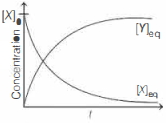
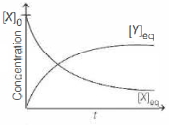
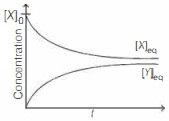
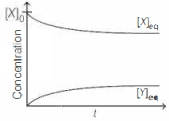
MediumConsider the following reversible first-order reaction of $X$ at an initial concentration $[X]_{0}$. The values of the rate constants are $K_{f} = 2 \ s^{-1}$ and $K_{b} = 1 \ s^{-1}$.
$X \underset{K_{b}}{\stackrel{K_{f}}{\rightleftharpoons}} Y$
Which of the following plots correctly represents the concentration of $X$ and $Y$ as a function of time?
$X \underset{K_{b}}{\stackrel{K_{f}}{\rightleftharpoons}} Y$
Which of the following plots correctly represents the concentration of $X$ and $Y$ as a function of time?
- A
- B
- C
- D
Explore More
Similar Questions
Ammonia under a pressure of $15 \ atm$ at $27 \ ^{\circ}C$ is heated to $347 \ ^{\circ}C$ in a closed vessel in the presence of a catalyst. Under these conditions,$NH_3$ is partially decomposed according to the equation,$2NH_3 \rightleftharpoons N_2 + 3H_2$. The vessel is such that the volume remains constant,and the pressure increases to $50 \ atm$. Calculate the percentage of $NH_3$ actually decomposed.
DifficultIIT 1981
View SolutionWhich one of the following statements is correct for a reversible reaction? $A$ catalyst
Medium
View SolutionFor a reaction taking place in a container in equilibrium with its surroundings,the effect of temperature on its equilibrium constant $K$ in terms of change in entropy is described by:
Attainment of the equilibrium $A_{(g)} \rightleftharpoons 3C_{(g)} + 2B_{(g)}$ gave the following graph. Find the correct option. $(\text{Percentage dissociation} = \text{fraction dissociated} \times 100)$
Difficult
View SolutionIn a closed vessel of $1 \ L$ capacity,$2 \ mol$ of $N_2$ and $6 \ mol$ of $H_2$ are mixed. If at equilibrium $50\% \ N_2$ is converted into $NH_3$,then the value of $K_c$ for the reaction $N_{2(g)} + 3H_{2(g)} \rightleftharpoons 2NH_{3(g)}$ will be:
Medium
View SolutionVedclass Products
For Students
Vedclass Test Series
Mock tests in real JEE/NEET style with performance analysis. 5-day free trial.
Start Free TrialFor Teachers
Exam Paper Generator
Generate Set A/B/C/D exam papers from 7.5L+ questions in 2 minutes. 3 chapters free.
Try FreeFor Institutes
Online Exam Module
Live online exams with unlimited students, 360° analytics & white-label branding.
See Demo