
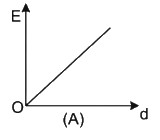
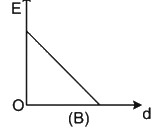
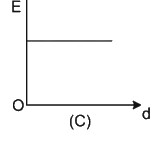
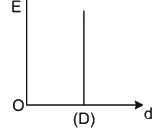
For a uniformly charged plane sheet, the variation of electric field $(E)$ with distance $(d)$ is correctly shown graphically in graph:
- A
- B
- C
- D
Explore More
Similar Questions
An infinite line charge produces a field of $7.182 \times 10^8 \, N/C$ at a distance of $2 \, cm$. The linear charge density is
Easy
View SolutionThree infinitely long charged sheets are placed as shown in the figure. The electric force acting on a charge $-q$ placed at the point $P$ is ($\sigma=$ surface charge density,$\varepsilon_0=$ permittivity of free space).
The electrostatic potential inside a charged spherical ball is given by $\Phi = a r^2 + b$,where $r$ is the distance from the centre and $a, b$ are constants. Then,the charge density inside the ball is ($\varepsilon_0 =$ permittivity in free space).
DifficultTS EAMCET 2020
View SolutionTwo parallel large thin metal sheets have equal surface charge densities $\sigma = 26.4 \times 10^{-12} \ C/m^2$ of the same sign. The electric field between these sheets is:
MediumAIIMS 2019
View SolutionThe magnitude of the average electric field normally present in the atmosphere just above the surface of the Earth is about $150\, N/C$,directed inward towards the center of the Earth. This gives the total net surface charge carried by the Earth to be......$kC$ [Given ${\varepsilon _0} = 8.85 \times {10^{ - 12}}\,{C^2}/(N \cdot m^2), {R_E} = 6.37 \times {10^6}\,m$]
DifficultJEE MAIN 2014
View SolutionVedclass Products
For Students
Vedclass Test Series
Mock tests in real JEE/NEET style with performance analysis. 5-day free trial.
Start Free TrialFor Teachers
Exam Paper Generator
Generate Set A/B/C/D exam papers from 7.5L+ questions in 2 minutes. 3 chapters free.
Try FreeFor Institutes
Online Exam Module
Live online exams with unlimited students, 360° analytics & white-label branding.
See Demo