
Difficult
For the equilibrium $A \rightleftharpoons B$,the variation of the rate of the forward $(a)$ and reverse $(b)$ reaction with time is given by:
- A
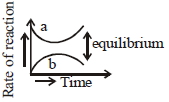
- B
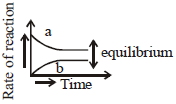
- C
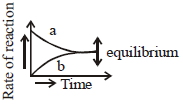
- D
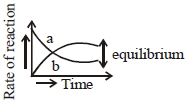
Explore More
Similar Questions
In the equilibrium $CH_3COOH + H_2O \rightleftharpoons CH_3COO^{-} + H_3O^{+}$,the equilibrium constant may change when:
Easy
View SolutionGiven the reactions at $500 \ K$:
$(i) \ H_{2(g)} + 1/2 O_{2(g)} \rightleftharpoons H_2O_{(g)}$,$K_c = 2.4 \times 10^{47}$
$(ii) \ H_2O_{(g)} \rightleftharpoons H_{2(g)} + 1/2 O_{2(g)}$,$K_c = 4.1 \times 10^{-48}$
What does the magnitude of $K_c$ indicate about the formation of the product in reaction $(i)$?
$(i) \ H_{2(g)} + 1/2 O_{2(g)} \rightleftharpoons H_2O_{(g)}$,$K_c = 2.4 \times 10^{47}$
$(ii) \ H_2O_{(g)} \rightleftharpoons H_{2(g)} + 1/2 O_{2(g)}$,$K_c = 4.1 \times 10^{-48}$
What does the magnitude of $K_c$ indicate about the formation of the product in reaction $(i)$?
Medium
View SolutionPure ammonia is placed in a vessel at a temperature where its dissociation constant $(\alpha)$ is appreciable. At equilibrium,
DifficultIIT 1984
View Solution$2 \ HI_{(g)} \rightleftharpoons H_{2(g)} + I_{2(g)}$
The equilibrium constant of the above reaction is $6.4$ at $300 \ K$. If $0.25 \ mol$ each of $H_{2}$ and $I_{2}$ are added to the system,the equilibrium constant will be
The equilibrium constant of the above reaction is $6.4$ at $300 \ K$. If $0.25 \ mol$ each of $H_{2}$ and $I_{2}$ are added to the system,the equilibrium constant will be
MediumKCET 2009
View SolutionSelect the incorrect statement $(s)$ regarding the state of equilibrium.
Easy
View SolutionVedclass Products
For Students
Vedclass Test Series
Mock tests in real JEE/NEET style with performance analysis. 5-day free trial.
Start Free TrialFor Teachers
Exam Paper Generator
Generate Set A/B/C/D exam papers from 7.5L+ questions in 2 minutes. 3 chapters free.
Try FreeFor Institutes
Online Exam Module
Live online exams with unlimited students, 360° analytics & white-label branding.
See Demo