
If $AB$ is an incident plane wave front,then what will be the refracted wave front for a lens with refractive index $n_2 > n_1$?
- A
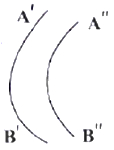
- B
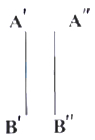
- C
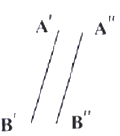
- D
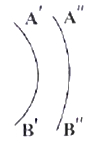
Explore More
Similar Questions
State Huygens' principle. What is the fundamental principle on which it is based?
Easy
View SolutionWhich of the following phenomena cannot be explained by Huygens' principle?
Medium
View SolutionThe main drawback of Huygens' theory was:
Easy
View SolutionHuygens' theory of secondary waves can be used to find:
Easy
View SolutionThe figure shows a surface $XY$ separating two transparent media,medium-$1$ and medium-$2$. The lines $ab$ and $cd$ represent wavefronts of a light wave travelling in medium-$1$ and incident on $XY$. The lines $ef$ and $gh$ represent wavefronts of the light wave in medium-$2$ after refraction.
$1.$ Light travels as a
$(A)$ parallel beam in each medium
$(B)$ convergent beam in each medium
$(C)$ divergent beam in each medium
$(D)$ divergent beam in one medium and convergent beam in the other medium.
$2.$ The phases of the light wave at $c, d, e$ and $f$ are $\phi_{c}, \phi_{d}, \phi_{e}$ and $\phi_{f}$ respectively. It is given that $\phi_{c} \neq \phi_{f}$.
$(A)$ $\phi_{c}$ cannot be equal to $\phi_{d}$
$(B)$ $\phi_{a}$ can be equal to $\phi_{e}$
$(C)$ $(\phi_{d}-\phi_{c})$ is equal to $(\phi_{f}-\phi_{e})$
$(D)$ $(\phi_{d}-\phi_{c})$ is not equal to $(\phi_{f}-\phi_{e})$
$3.$ Speed of the light is
$(A)$ the same in medium-$1$ and medium-$2$
$(B)$ larger in medium-$1$ than in medium-$2$
$(C)$ larger in medium-$2$ than in medium-$1$
$(D)$ different at $b$ and $d$
Give the answer for questions $1, 2$ and $3$.
$1.$ Light travels as a
$(A)$ parallel beam in each medium
$(B)$ convergent beam in each medium
$(C)$ divergent beam in each medium
$(D)$ divergent beam in one medium and convergent beam in the other medium.
$2.$ The phases of the light wave at $c, d, e$ and $f$ are $\phi_{c}, \phi_{d}, \phi_{e}$ and $\phi_{f}$ respectively. It is given that $\phi_{c} \neq \phi_{f}$.
$(A)$ $\phi_{c}$ cannot be equal to $\phi_{d}$
$(B)$ $\phi_{a}$ can be equal to $\phi_{e}$
$(C)$ $(\phi_{d}-\phi_{c})$ is equal to $(\phi_{f}-\phi_{e})$
$(D)$ $(\phi_{d}-\phi_{c})$ is not equal to $(\phi_{f}-\phi_{e})$
$3.$ Speed of the light is
$(A)$ the same in medium-$1$ and medium-$2$
$(B)$ larger in medium-$1$ than in medium-$2$
$(C)$ larger in medium-$2$ than in medium-$1$
$(D)$ different at $b$ and $d$
Give the answer for questions $1, 2$ and $3$.
Vedclass Products
For Students
Vedclass Test Series
Mock tests in real JEE/NEET style with performance analysis. 5-day free trial.
Start Free TrialFor Teachers
Exam Paper Generator
Generate Set A/B/C/D exam papers from 7.5L+ questions in 2 minutes. 3 chapters free.
Try FreeFor Institutes
Online Exam Module
Live online exams with unlimited students, 360° analytics & white-label branding.
See Demo