
In the following conversion,
$C_6H_5CN$ $\xrightarrow[(ii) H_3O^+]{(i) MeMgBr} X$ $\xrightarrow[H_3O^+]{NaOH/I_2} Y$
the major products $X$ and $Y$,respectively are
$C_6H_5CN$ $\xrightarrow[(ii) H_3O^+]{(i) MeMgBr} X$ $\xrightarrow[H_3O^+]{NaOH/I_2} Y$
the major products $X$ and $Y$,respectively are
- A$I$
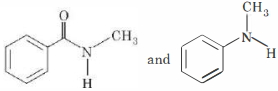
- B$II$
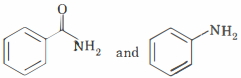
- C$III$
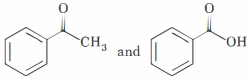
- D$IV$
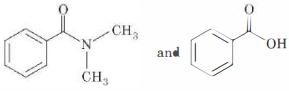
Explore More
Similar Questions
Which of the following compounds is the least reactive towards nucleophilic addition reactions?
An alkene $(A)$ $C_{16}H_{16}$ on ozonolysis gives only one product $(B)$ $C_8H_8O$. $(B)$ can also be obtained by the hydrolysis of the product obtained from the reaction between cyanobenzene and $CH_3MgBr$. $(A)$ shows geometrical isomerism and decolourises $Br_2$ water. $(B)$ on treatment with $SeO_2$ produces $(C)$. Which statement is not correct about $(C)$?
Consider the following sequence of reactions:
Ketone $A$ $\xrightarrow[2. H_2O]{1. C_2H_5MgBr} B$ $\xrightarrow[- H_2O]{H_2SO_4, \text{Heat}} C$ $\xrightarrow[2. Zn, H_2O]{1. O_3} \text{Propanone} + \text{Acetaldehyde}$
The ketone $A$ is:
Ketone $A$ $\xrightarrow[2. H_2O]{1. C_2H_5MgBr} B$ $\xrightarrow[- H_2O]{H_2SO_4, \text{Heat}} C$ $\xrightarrow[2. Zn, H_2O]{1. O_3} \text{Propanone} + \text{Acetaldehyde}$
The ketone $A$ is:
Medium
View SolutionWhich of the following does $NOT$ give a yellow precipitate when reacted with a $(NaOH + I_{2})$ mixture?
Aldehydes and ketones can be reduced to corresponding hydrocarbons by
Medium
View SolutionVedclass Products
For Students
Vedclass Test Series
Mock tests in real JEE/NEET style with performance analysis. 5-day free trial.
Start Free TrialFor Teachers
Exam Paper Generator
Generate Set A/B/C/D exam papers from 7.5L+ questions in 2 minutes. 3 chapters free.
Try FreeFor Institutes
Online Exam Module
Live online exams with unlimited students, 360° analytics & white-label branding.
See Demo