
Let $R$ denote the set of all real numbers and $R^{+}$ denote the set of all positive real numbers. For the subsets $A$ and $B$ of $R$, define $f: A \rightarrow B$ by $f(x) = x^2$ for $x \in A$. Match the following lists:
| Column $I$ | Column $II$ |
| :--- | :--- |
| $A$. $f$ is one-one and onto, if | $1$. $A = R^{+}, B = R$ |
| $B$. $f$ is one-one but not onto, if | $2$. $A = B = R$ |
| $C$. $f$ is onto but not one-one, if | $3$. $A = R, B = R^{+}$ |
| $D$. $f$ is neither one-one nor onto, if | $4$. $A = B = R^{+}$ |
| Column $I$ | Column $II$ |
| :--- | :--- |
| $A$. $f$ is one-one and onto, if | $1$. $A = R^{+}, B = R$ |
| $B$. $f$ is one-one but not onto, if | $2$. $A = B = R$ |
| $C$. $f$ is onto but not one-one, if | $3$. $A = R, B = R^{+}$ |
| $D$. $f$ is neither one-one nor onto, if | $4$. $A = B = R^{+}$ |
- A
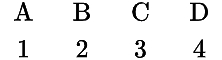
- B
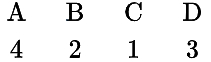
- C
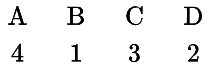
- D
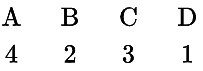
Explore More
Similar Questions
Which one of the following best represents the graph of the function $f(x) = \lim_{n \to \infty} \frac{2}{\pi} \tan^{-1}(nx)$?
The number of roots of the equation $\sqrt{2}+e^{\cosh^{-1} x}-e^{\sinh^{-1} x}=0$ is
Let $A = \{1, 3, 4, 6, 9\}$ and $B = \{2, 4, 5, 8, 10\}$. Let $R$ be a relation defined on $A \times B$ such that $R = \{((a_1, b_1), (a_2, b_2)) : a_1 \leq b_2 \text{ and } b_1 \leq a_2\}$. Then the number of elements in the set $R$ is
DifficultJEE MAIN 2023
View SolutionIf $f(x)=\frac{2^{x}+2^{-x}}{2}$,then $f(x+y) \cdot f(x-y)$ is
Answer the following by appropriately matching the lists based on the information given in the paragraph.
Let $f(x) = \sin(\pi \cos x)$ and $g(x) = \cos(2\pi \sin x)$ be two functions defined for $x > 0$. Define the following sets whose elements are written in increasing order:
$X = \{x : f(x) = 0\}, Y = \{x : f'(x) = 0\}$
$Z = \{x : g(x) = 0\}, W = \{x : g'(x) = 0\}$
$List-I$ contains the sets $X, Y, Z$ and $W$. $List-II$ contains some information regarding these sets.
$List-I$ $List-II$ $(I) X$ $(P) \supseteq \{\frac{\pi}{2}, \frac{3\pi}{2}, 4\pi, 7\pi\}$ $(II) Y$ $(Q) \text{ an arithmetic progression}$ $(III) Z$ $(R) \text{ NOT an arithmetic progression}$ $(IV) W$ $(S) \supseteq \{\frac{\pi}{6}, \frac{7\pi}{6}, \frac{13\pi}{6}\}$ $(T) \supseteq \{\frac{\pi}{3}, \frac{2\pi}{3}, \pi\}$ $(U) \supseteq \{\frac{\pi}{6}, \frac{3\pi}{4}\}$
$(1)$ Which of the following is the only $CORRECT$ combination?
$(1) (II), (R), (S)$ $(2) (I), (P), (R)$ $(3) (II), (Q), (T)$ $(4) (I), (Q), (U)$
$(2)$ Which of the following is the only $CORRECT$ combination?
$(1) (IV), (Q), (T)$ $(2) (IV), (P), (R), (S)$ $(3) (III), (R), (U)$ $(4) (III), (P), (Q), (U)$
Let $f(x) = \sin(\pi \cos x)$ and $g(x) = \cos(2\pi \sin x)$ be two functions defined for $x > 0$. Define the following sets whose elements are written in increasing order:
$X = \{x : f(x) = 0\}, Y = \{x : f'(x) = 0\}$
$Z = \{x : g(x) = 0\}, W = \{x : g'(x) = 0\}$
$List-I$ contains the sets $X, Y, Z$ and $W$. $List-II$ contains some information regarding these sets.
| $List-I$ | $List-II$ |
| $(I) X$ | $(P) \supseteq \{\frac{\pi}{2}, \frac{3\pi}{2}, 4\pi, 7\pi\}$ |
| $(II) Y$ | $(Q) \text{ an arithmetic progression}$ |
| $(III) Z$ | $(R) \text{ NOT an arithmetic progression}$ |
| $(IV) W$ | $(S) \supseteq \{\frac{\pi}{6}, \frac{7\pi}{6}, \frac{13\pi}{6}\}$ |
| $(T) \supseteq \{\frac{\pi}{3}, \frac{2\pi}{3}, \pi\}$ | |
| $(U) \supseteq \{\frac{\pi}{6}, \frac{3\pi}{4}\}$ |
$(1)$ Which of the following is the only $CORRECT$ combination?
$(1) (II), (R), (S)$ $(2) (I), (P), (R)$ $(3) (II), (Q), (T)$ $(4) (I), (Q), (U)$
$(2)$ Which of the following is the only $CORRECT$ combination?
$(1) (IV), (Q), (T)$ $(2) (IV), (P), (R), (S)$ $(3) (III), (R), (U)$ $(4) (III), (P), (Q), (U)$
Vedclass Products
For Students
Vedclass Test Series
Mock tests in real JEE/NEET style with performance analysis. 5-day free trial.
Start Free TrialFor Teachers
Exam Paper Generator
Generate Set A/B/C/D exam papers from 7.5L+ questions in 2 minutes. 3 chapters free.
Try FreeFor Institutes
Online Exam Module
Live online exams with unlimited students, 360° analytics & white-label branding.
See Demo